Miejsca


Places is a collection of notes on localities, parishes, estates, and landed properties connected with the history of the Wadowski Pietrzkiewicz family. These descriptions make it possible to place the history of the family within the specific landscape of old Lithuania, Samogitia, Livonia, and the other lands to which family migrations led. They include information on historical names, location, parish and administrative affiliation, owners, historical events, and traces left by the Pietrzkiewiczes in documents and family tradition.
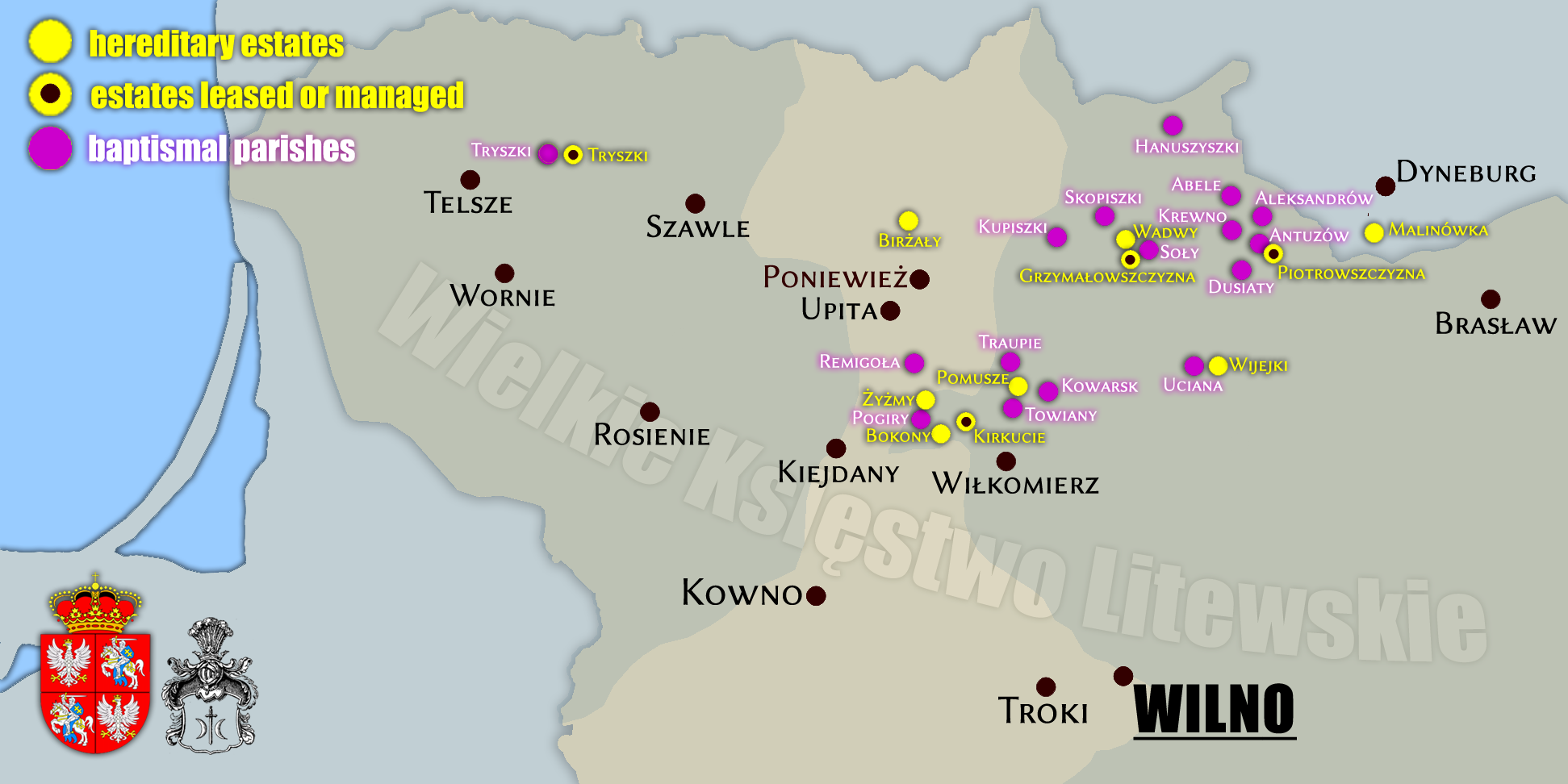
Places associated with the Pietrzkiewicz family in Lithuania, 17th-20th centuries
Wadwy
Coordinates: 55.84146, 25.29241
Wadwy (Lith. Vaduvos) was once a village and landed estate on the Wadwa stream, situated in the Wiłkomierz (Lith. Ukmergė) district of the Vilnius Voivodeship of the Grand Duchy of Lithuania, south-east of the town of Skopiszki (Lith. Skapiškis).
According to the entry in the Kupiškis Encyclopedia, the first known owner of Wadwy and the surrounding lands was Jarosław Hołowszczyński (c. 1510–1567), royal marshal and starosta of Kowno (Lith. Kaunas).
In the Kupiškis Encyclopedia, vol. III, p. 470, it is stated - unfortunately without giving the date of the privilege - that the King of Poland and Grand Duke of Lithuania Sigismund the Old granted lands in Wadwy to the boyars Pietrykiewicz, who over time took from these estates the byname Wadowski. In turn, in the 1806 proof of nobility of the Pietrzkiewicz family, it was written that Piotr, son of Urban, in 1532 purchased from the Butkiewicz brothers the manor and land of Radkowszczyzna, adding them to his paternal estate in Wadwy. However, the preserved copy of the 1532 document shows that the brothers Hryc and Mikołaj Butkiewicz donated the manor and land of Radkowszczyzna to Piotr Urbanowicz, married to their sister Katarzyna. Explaining these discrepancies requires further research.
Piotr and Katarzyna had numerous offspring; however, in 1584 they transferred the entire estate to their son Wojciech, omitting the remaining children, unnamed in the sources. Wojciech’s unknown siblings probably lived in Wadwy, and it is likely from them that the numerous Pietrzkiewiczes recorded in the registers of the Skopiszki church, but omitted from the 1806 proof of nobility of the Pietrzkiewicz family, descended. The sources do not name Wojciech’s wife, with whom he had at least two sons, Krzysztof and Wawrzyniec-Samuel. In 1632 Wojciech, near the end of his life, divided the estate inherited from his parents between his sons, who gave rise to two lines of the family: Krzysztof to the elder line, and Wawrzyniec-Samuel to the younger one.
In the 1806 proof of nobility it was written that Krzysztof, son of Wojciech, was heir to half of Wadwy and Dziewianiszki. It is not known whether Krzysztof inherited Dziewianiszki from his father or purchased them himself. The later records show, however, that all his sons — Daniel, Kazimierz, Konstanty and Albrecht — had shares in Dziewianiszki, and that after his death, before 1671, they received their portions in Wadwy. Wojciech’s younger son, Wawrzyniec-Samuel, left one documented descendant, Gabriel, who in 1650 issued to his wife Regina a pledge deed on his estate in Wadwy.
During the eighteenth century, further changes occurred in the Pietrzkiewicz family’s shares in Wadwy.
The elder line
Of Krzysztof’s sons, the eldest, Daniel, leased out his part of Wadwy to his nephew Teofil in 1700, and then sold it in 1703. Apart from daughters, Daniel had a son, Felicjan, who probably died in childhood, since Daniel’s line died out with him. Krzysztof’s second son, Kazimierz, in 1671 bought from his youngest brother Albrecht his part of Wadwy, and in the same year leased out his Dziewianiszki to the Hrehorowiczes. Kazimierz had two sons, Józef and Teofil. In 1683 Kazimierz assigned part of his Wadwy and Dziewianiszki to Teofil. It is not known whether he assigned anything to his other son, Józef. There is also no further information about Krzysztof’s third son, Konstanty; we only know that he had three sons, among whom he probably divided his part of Wadwy. The later fate of Albrecht is unknown.
Kazimierz and his wife Anna-Dorota née Stynawiec had two sons, Józef and Teofil. Józef was not married and left no descendants. Teofil, with his wife Katarzyna née Paszkiewicz, held his father’s Wadwy and Dziewianiszki from 1683. He had a son, Kazimierz. In 1700 Teofil leased, and in 1703 purchased, his uncle Daniel’s part of Wadwy. Around 1738 Teofil, together with his brother Józef, sold to Jakub Kontrymowicz the part of Wadwy after Albrecht that had been purchased by their father.
Of Konstanty’s sons, Piotr and Andrzej inherited their shares, as is shown by later documents. Jan, however, was a monk in the Order of St Basil, and it is not known whether he had a share in his father’s inheritance. It is not known whether Piotr founded a family. Andrzej was married to Krystyna Ilcewicz, with whom he had five sons: Jakub, Konstanty, Jerzy, Franciszek and Antoni. In 1728–1732 Krystyna, Andrzej’s wife, and perhaps already his widow, acting on behalf of her sons, was involved in a lawsuit with Kazimierz, son of Teofil, over the Dziewianiszki lands.
The younger line
Gabriel died after 1668. Before his death, he granted his Wadwy to his wife Regina as a life interest. After Gabriel’s death, Regina married again, to Karol Tyszka of Wadwy, and held part of Wadwy until her son Krzysztof-Jan came of age in 1699. In 1703 Krzysztof-Jan, son of Gabriel, leased part of Wadwy from Daniel, son of Krzysztof.
Krzysztof-Jan and his wife Barbara née Klicner had two sons, Tobiasz-Hieronim and Wincenty. In 1736, after Krzysztof-Jan’s death, on the basis of their father’s testament, the sons divided the paternal estate: Wadwy passed to Tobiasz-Hieronim, and Pomusze to Wincenty.
In the 1740s, the Pietrzkiewicz family’s shares in Wadwy were almost completely sold off.
The elder line
First, in 1743, Piotr, son of Konstanty, sold the part of Wadwy inherited from his father to Wincenty, son of Krzysztof-Jan.
Later, Teofil, son of Kazimierz, in agreement with his brother Józef, transferred their parts of Wadwy to Jakub Kontrymowicz, who was married to Anna, Teofil’s daughter, as is known from the testament of Józef, son of Kazimierz, drawn up in 1748. Teofil’s son Kazimierz inherited only his father’s Dziewianiszki, which he soon sold to Jan and Jadwiga Tupalski in 1749.
In the same year, 1748, two sons of Andrzej, Franciszek and Jerzy, were in dispute with Jakub Kontrymowicz over the land after their grandfather Krzysztof. The fate of their brothers Konstanty and Jakub is unknown, while Antoni, after marrying Marianna Ryka, probably left Wadwy.
The younger line
After the death of his brother Tobiasz, Wincenty inherited his Wadwy; in 1743 he purchased Piotr Pietrzkiewicz’s part of Wadwy, and then, in 1744, sold all the lands in Wadwy to Franciszek Świrski.
Of the area that had belonged to the family in the sixteenth century, after 1744 only small fragments of Wadwy remained in the hands of the Pietrzkiewiczes, belonging to Andrzej’s sons, Jerzy and Franciszek. After Jerzy, the estate was inherited by his son Stanisław, and after Franciszek probably by his sons Antoni and Mateusz-Tadeusz. Two documents concerning the sale of Wadwy to Ignacy Zyndram-Kościałkowski, marshal of the Wiłkomierz district, have survived in the Wiłkomierz land-court protocol book. In the spring of 1782, exactly 250 years after the Butkiewiczes’ donation to Piotr, son of Urban, two transactions took place: Stanisław Pietrzkiewicz and the brothers Antoni and Tadeusz sold their estates to Ignacy Kościałkowski — probably the last properties in Wadwy still remaining in the hands of the family.
Apart from the Pietrzkiewiczes, many boyar families had farmed in Wadwy since the sixteenth century: the Brzeskis, Butkiewiczes, Downarowiczes, Hrehorowiczes, Klimowiczes, Kontrymowiczes, Narkiewiczes, Pacewskis, Torczyłos, Tupalskis, Tyszkas and others. By the end of the eighteenth century, most of Wadwy had been bought up by the Zyndram-Kościałkowski family.
Despite the sale of their hereditary land in Wadwy, many Pietrzkiewicz family members still remained in the area. This is shown by numerous metrical records from the books of the Skopiszki church, in which the Pietrzkiewicz surname continued to appear regularly until the mid-nineteenth century. However, it has not yet been possible to establish their place in the family tree.
The description of the Skopiszki (Lith. Skapiškis) parish from 1784, prepared by the parish priest, Father Ignacy-Józef Dunin-Borkowski, already lists Wadwy as a manor and village belonging to Kościałkowski, the marshal of Wiłkomierz (Lith. Ukmergė). Interestingly, in his description of the parish, Father Borkowski mentions a windmill in Wadwy which was already “useless” at that time. The ruins of this windmill, together with the hillfort, remain the most characteristic feature of the Wadwy landscape.
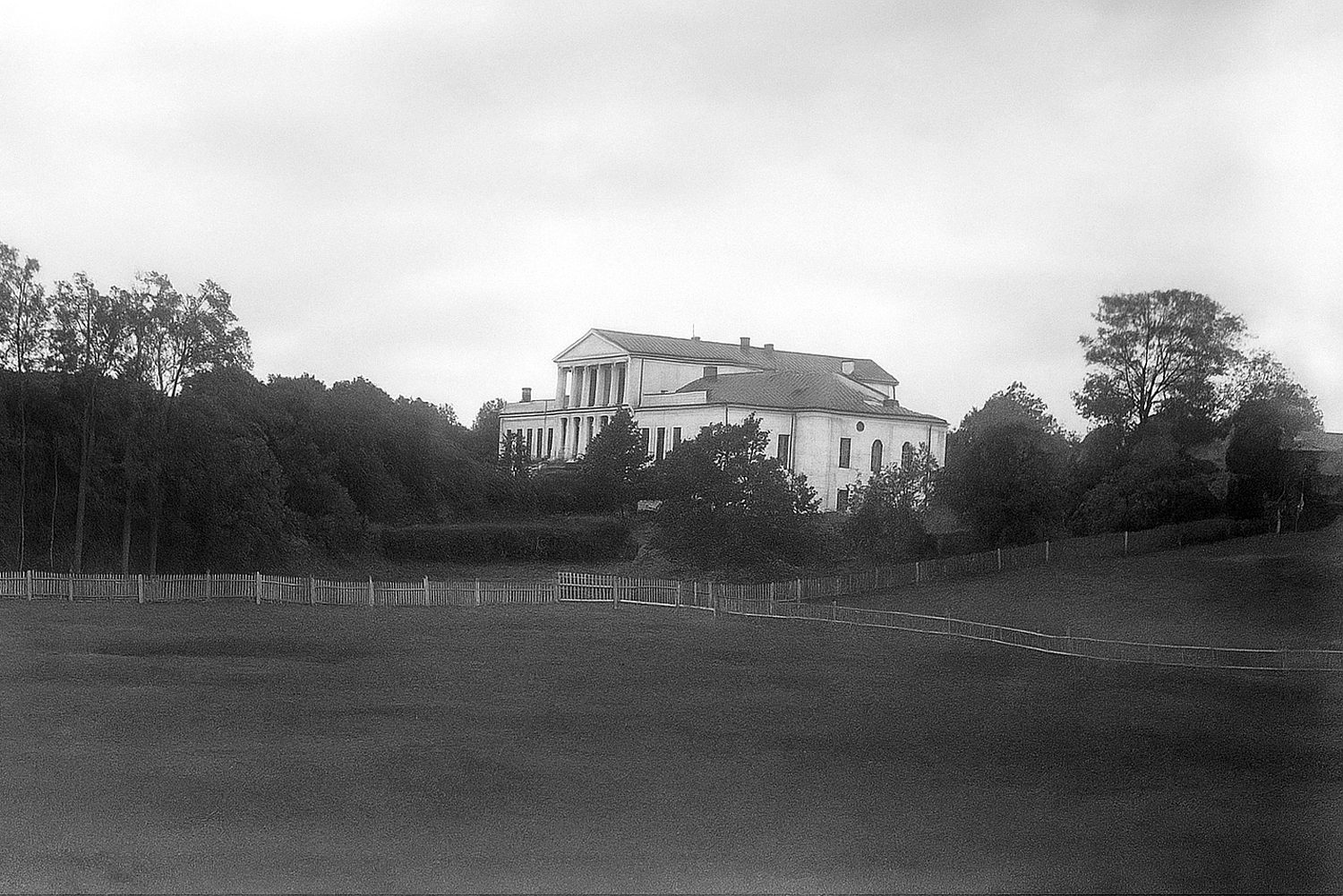
In the report of the visitation of the Skopiszki (Lith. Skapiškis) parish for 1830, it was recorded that the Wadwy manor, together with the villages of Zawadwy (Lith. Ažvadžiai), Kiepury (Lith. Kepurai), Wergucie (Lith. Vergučiai) and Pacewskie (Lith. Pocauskai), alias Górne Kondrany, belonged to the “Most Illustrious” Mrs Pietkiewicz. Around the middle of the nineteenth century Wadwy passed from the hands of the Pietkiewiczes to the Koziełł-Poklewski family. Around 1857 the new owners built an impressive palace in Wadwy, visible in the photograph above. The palace was destroyed in 1915 by retreating Russian troops.
The Geographical Dictionary of the Kingdom of Poland (vol. XII, 1892) describes Wadwy as an estate on the Jura River, in the Nowoaleksandrowsk district, in the commune and parish of Skopiszki (Lith. Skapiškis), 76 versts from Nowoaleksandrowsk, that is, Jeziorosy (Lith. Zarasai). According to this description, in 1859 there were 13 inhabitants, a distillery operated there, and the estate belonged to the Koziełł family and comprised 740 dessiatins of land.
Today Wadwy is only a geographical name, as it is no longer inhabited.
Wadwy (Lith. Vaduvos) was once a village and landed estate on the Wadwa stream, situated in the Wiłkomierz (Lith. Ukmergė) district of the Vilnius Voivodeship of the Grand Duchy of Lithuania, south-east of the town of Skopiszki (Lith. Skapiškis).
Wadwy, the Koziełł-Poklewski manor house, before the First World War - LVIA
According to the entry in the Kupiškis Encyclopedia, the first known owner of Wadwy and the surrounding lands was Jarosław Hołowszczyński (c. 1510–1567), royal marshal and starosta of Kowno (Lith. Kaunas).
In the Kupiškis Encyclopedia, vol. III, p. 470, it is stated - unfortunately without giving the date of the privilege - that the King of Poland and Grand Duke of Lithuania Sigismund the Old granted lands in Wadwy to the boyars Pietrykiewicz, who over time took from these estates the byname Wadowski. In turn, in the 1806 proof of nobility of the Pietrzkiewicz family, it was written that Piotr, son of Urban, in 1532 purchased from the Butkiewicz brothers the manor and land of Radkowszczyzna, adding them to his paternal estate in Wadwy. However, the preserved copy of the 1532 document shows that the brothers Hryc and Mikołaj Butkiewicz donated the manor and land of Radkowszczyzna to Piotr Urbanowicz, married to their sister Katarzyna. Explaining these discrepancies requires further research.
Piotr and Katarzyna had numerous offspring; however, in 1584 they transferred the entire estate to their son Wojciech, omitting the remaining children, unnamed in the sources. Wojciech’s unknown siblings probably lived in Wadwy, and it is likely from them that the numerous Pietrzkiewiczes recorded in the registers of the Skopiszki church, but omitted from the 1806 proof of nobility of the Pietrzkiewicz family, descended. The sources do not name Wojciech’s wife, with whom he had at least two sons, Krzysztof and Wawrzyniec-Samuel. In 1632 Wojciech, near the end of his life, divided the estate inherited from his parents between his sons, who gave rise to two lines of the family: Krzysztof to the elder line, and Wawrzyniec-Samuel to the younger one.
In the 1806 proof of nobility it was written that Krzysztof, son of Wojciech, was heir to half of Wadwy and Dziewianiszki. It is not known whether Krzysztof inherited Dziewianiszki from his father or purchased them himself. The later records show, however, that all his sons — Daniel, Kazimierz, Konstanty and Albrecht — had shares in Dziewianiszki, and that after his death, before 1671, they received their portions in Wadwy. Wojciech’s younger son, Wawrzyniec-Samuel, left one documented descendant, Gabriel, who in 1650 issued to his wife Regina a pledge deed on his estate in Wadwy.
Simplified diagram of the Pietrzkiewicz family’s shares in Wadwy in 1671
- A - Daniel, son of Krzysztof
- B - Konstanty, son of Krzysztof
- C - Kazimierz, son of Krzysztof
- D - Albrecht, son of Krzysztof
- E - Gabriel and Regina née Tynhazen, the Pietrzkiewicz couple
The elder line
Of Krzysztof’s sons, the eldest, Daniel, leased out his part of Wadwy to his nephew Teofil in 1700, and then sold it in 1703. Apart from daughters, Daniel had a son, Felicjan, who probably died in childhood, since Daniel’s line died out with him. Krzysztof’s second son, Kazimierz, in 1671 bought from his youngest brother Albrecht his part of Wadwy, and in the same year leased out his Dziewianiszki to the Hrehorowiczes. Kazimierz had two sons, Józef and Teofil. In 1683 Kazimierz assigned part of his Wadwy and Dziewianiszki to Teofil. It is not known whether he assigned anything to his other son, Józef. There is also no further information about Krzysztof’s third son, Konstanty; we only know that he had three sons, among whom he probably divided his part of Wadwy. The later fate of Albrecht is unknown.
Kazimierz and his wife Anna-Dorota née Stynawiec had two sons, Józef and Teofil. Józef was not married and left no descendants. Teofil, with his wife Katarzyna née Paszkiewicz, held his father’s Wadwy and Dziewianiszki from 1683. He had a son, Kazimierz. In 1700 Teofil leased, and in 1703 purchased, his uncle Daniel’s part of Wadwy. Around 1738 Teofil, together with his brother Józef, sold to Jakub Kontrymowicz the part of Wadwy after Albrecht that had been purchased by their father.
Of Konstanty’s sons, Piotr and Andrzej inherited their shares, as is shown by later documents. Jan, however, was a monk in the Order of St Basil, and it is not known whether he had a share in his father’s inheritance. It is not known whether Piotr founded a family. Andrzej was married to Krystyna Ilcewicz, with whom he had five sons: Jakub, Konstanty, Jerzy, Franciszek and Antoni. In 1728–1732 Krystyna, Andrzej’s wife, and perhaps already his widow, acting on behalf of her sons, was involved in a lawsuit with Kazimierz, son of Teofil, over the Dziewianiszki lands.
The younger line
Gabriel died after 1668. Before his death, he granted his Wadwy to his wife Regina as a life interest. After Gabriel’s death, Regina married again, to Karol Tyszka of Wadwy, and held part of Wadwy until her son Krzysztof-Jan came of age in 1699. In 1703 Krzysztof-Jan, son of Gabriel, leased part of Wadwy from Daniel, son of Krzysztof.
Krzysztof-Jan and his wife Barbara née Klicner had two sons, Tobiasz-Hieronim and Wincenty. In 1736, after Krzysztof-Jan’s death, on the basis of their father’s testament, the sons divided the paternal estate: Wadwy passed to Tobiasz-Hieronim, and Pomusze to Wincenty.
Simplified diagram of the Pietrzkiewicz family’s shares in Wadwy in 1738
- from 1703 - Teofil, son of Kazimierz
- Piotr, son of Konstanty
- Andrzej, son of Konstanty
- Teofil, son of Kazimierz
- Józef, son of Kazimierz
- JK - from 1671 - Kazimierz, then Teofil, from around 1738 - Jakub Kontrymowicz, Teofil’s son-in-law
- from 1699 - Krzysztof-Jan, from 1736 - Tobiasz-Hieronim
The elder line
First, in 1743, Piotr, son of Konstanty, sold the part of Wadwy inherited from his father to Wincenty, son of Krzysztof-Jan.
Later, Teofil, son of Kazimierz, in agreement with his brother Józef, transferred their parts of Wadwy to Jakub Kontrymowicz, who was married to Anna, Teofil’s daughter, as is known from the testament of Józef, son of Kazimierz, drawn up in 1748. Teofil’s son Kazimierz inherited only his father’s Dziewianiszki, which he soon sold to Jan and Jadwiga Tupalski in 1749.
In the same year, 1748, two sons of Andrzej, Franciszek and Jerzy, were in dispute with Jakub Kontrymowicz over the land after their grandfather Krzysztof. The fate of their brothers Konstanty and Jakub is unknown, while Antoni, after marrying Marianna Ryka, probably left Wadwy.
The younger line
After the death of his brother Tobiasz, Wincenty inherited his Wadwy; in 1743 he purchased Piotr Pietrzkiewicz’s part of Wadwy, and then, in 1744, sold all the lands in Wadwy to Franciszek Świrski.
Simplified diagram of the Pietrzkiewicz family’s shares in Wadwy in 1748
- FŚ — Piotr, son of Konstanty, until 1743; Wincenty, son of Krzysztof-Jan, until 1744; after him Franciszek Świrski
- FJ — Franciszek and Jerzy, sons of Andrzej
- JK — Jakub Kontrymowicz, Teofil’s son-in-law, parts after the brothers Teofil and Józef, sons of Kazimierz
- FŚ — from 1736 — Tobiasz-Hieronim, after him his brother Wincenty, from 1744 Franciszek Świrski
Apart from the Pietrzkiewiczes, many boyar families had farmed in Wadwy since the sixteenth century: the Brzeskis, Butkiewiczes, Downarowiczes, Hrehorowiczes, Klimowiczes, Kontrymowiczes, Narkiewiczes, Pacewskis, Torczyłos, Tupalskis, Tyszkas and others. By the end of the eighteenth century, most of Wadwy had been bought up by the Zyndram-Kościałkowski family.
Despite the sale of their hereditary land in Wadwy, many Pietrzkiewicz family members still remained in the area. This is shown by numerous metrical records from the books of the Skopiszki church, in which the Pietrzkiewicz surname continued to appear regularly until the mid-nineteenth century. However, it has not yet been possible to establish their place in the family tree.
The description of the Skopiszki (Lith. Skapiškis) parish from 1784, prepared by the parish priest, Father Ignacy-Józef Dunin-Borkowski, already lists Wadwy as a manor and village belonging to Kościałkowski, the marshal of Wiłkomierz (Lith. Ukmergė). Interestingly, in his description of the parish, Father Borkowski mentions a windmill in Wadwy which was already “useless” at that time. The ruins of this windmill, together with the hillfort, remain the most characteristic feature of the Wadwy landscape.
In the report of the visitation of the Skopiszki (Lith. Skapiškis) parish for 1830, it was recorded that the Wadwy manor, together with the villages of Zawadwy (Lith. Ažvadžiai), Kiepury (Lith. Kepurai), Wergucie (Lith. Vergučiai) and Pacewskie (Lith. Pocauskai), alias Górne Kondrany, belonged to the “Most Illustrious” Mrs Pietkiewicz. Around the middle of the nineteenth century Wadwy passed from the hands of the Pietkiewiczes to the Koziełł-Poklewski family. Around 1857 the new owners built an impressive palace in Wadwy, visible in the photograph above. The palace was destroyed in 1915 by retreating Russian troops.
The Geographical Dictionary of the Kingdom of Poland (vol. XII, 1892) describes Wadwy as an estate on the Jura River, in the Nowoaleksandrowsk district, in the commune and parish of Skopiszki (Lith. Skapiškis), 76 versts from Nowoaleksandrowsk, that is, Jeziorosy (Lith. Zarasai). According to this description, in 1859 there were 13 inhabitants, a distillery operated there, and the estate belonged to the Koziełł family and comprised 740 dessiatins of land.
Today Wadwy is only a geographical name, as it is no longer inhabited.
Skopiszki
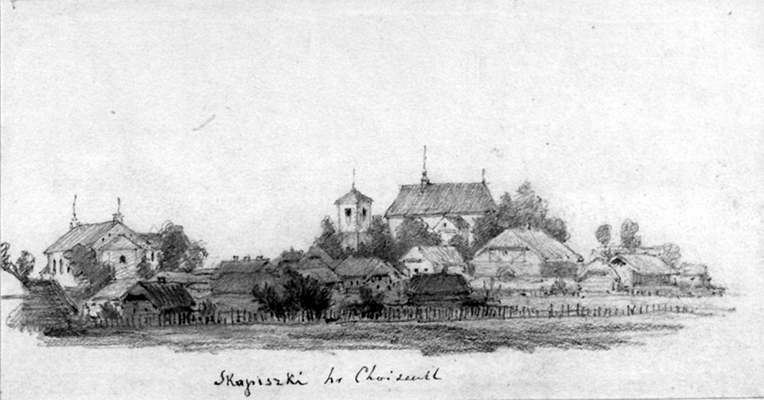
Panorama of Skopiszki, drawing by Alfred Romer - LMAVB
Skopiszki (Lith. Skapiškis) is a town situated on Lake Mitowo, formerly in the Wiłkomierz (Lith. Ukmergė) district of the Vilnius Voivodeship, and today in the Kupiškis district of Lithuania. The origins of the settlement date back to the turn of the fifteenth and sixteenth centuries. Initially known as Mitowo, it later adopted the name Skopiszki, probably from the Skop family.
At the turn of the fifteenth and sixteenth centuries, Grand Duke Alexander granted permission to hold markets in Skopiszki. In 1555 Stanisław Skop endowed the parish of Skopiszki with more than 22 włókas of land, together with the villages of Biluny and Kreypsze (Lith. Kreipšiai). In 1633 Władysław IV Vasa granted Tobiasz Skop permission to establish a town and hold markets in his estates of Mitowo and Skopiszki. In 1666 permission was again granted for a market and four annual fairs, and in 1668 this privilege was confirmed.
In 1744 Skopiszki was listed in the report of the synod of the Diocese of Vilnius as the seat of a parish in the Kupiškis deanery. The Church of St Lawrence, which had existed at least since 1519, was one of the oldest stone churches in northern Lithuania. For centuries, members of the Wadowski Pietrzkiewicz family were buried in this church and in the adjoining parish cemetery.
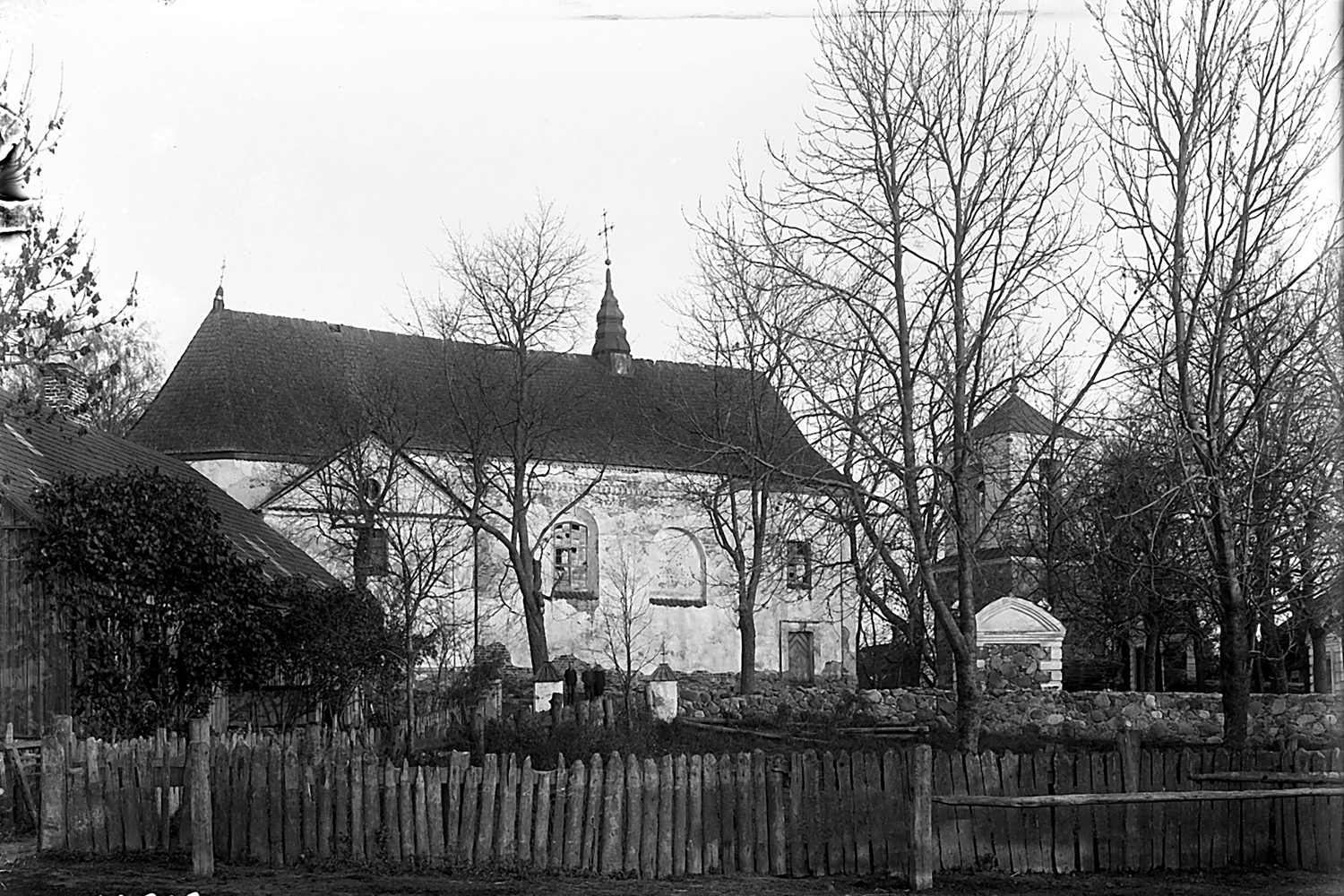
Skopiszki, St Lawrence’s Church before the First World War - LVIA
In 1750 the Dominicans began their activity in Skopiszki. In 1752 they founded a monastery, endowed by Józef Dominik Puzyna, Bishop of Livonia; in 1756 they built a church; and in 1775 they opened a parish school. After the November Uprising, the Dominican monastery was dissolved by the tsarist authorities.
In his 1784 description of the Skopiszki parish, Father Borkowski stated that half of the town of Skopiszki, called Anczkol, belonged to the Tyzenhauz family.
The present Church of St Hyacinth dates from 1819. Some of its furnishings were transferred from the old Church of St Lawrence, which ceased to serve as the parish church in 1858.
The report of the visitation of the Skopiszki parish for 1830 recorded that the parish had a total of 2,014 male and 2,130 female parishioners. In that year 39 couples were married, 83 boys and 82 girls were born, and 120 male and 124 female parishioners died.
The Geographical Dictionary of the Kingdom of Poland (vol. X, 1889) states, among other things, that Skopiszki lay in the Nowoaleksandrowsk district, on the border of the Wiłkomierz (Lith. Ukmergė) district, and that the town had 60 houses and 422 inhabitants. At that time there were two churches there: St Lawrence’s Church in the cemetery and the former Dominican church. Skopiszki also had a synagogue, military barracks, a commune office and a village school. Half of the town belonged to the Counts Choiseul, a French comital family that had settled in Lithuania after emigrating from France during the French Revolution, and the other half belonged to the government.
In 1893 a railway line from Dyneburg to Radziwiliszki, a railway junction on the line leading to Libawa, was built near Skopiszki. This led to the establishment of the Skopiszki railway station.
During the First World War, the already disused Church of St Lawrence was dismantled by order of the German occupation authorities because it was in danger of collapsing. The building materials obtained in this way were used to pave the streets of Skopiszki.
Pomusze
Pomusze (Lith. Pamūšis) – the exact location of these estates is difficult to establish. The name itself indicates that they were situated on the Musza River, but places called Pomusze existed, and still exist, in several locations in Lithuania.
A description of the parishes of the Wiłkomierz (Lith. Ukmergė) deanery, drawn up in 1784, proved helpful in determining the approximate location of Pomusze. It shows that Pomusze was a group of estates belonging to many different owners, situated in the triangle between Wiłkomierz, Kowarsk and Towiany (Lith. Ukmergė–Kavarskas–Taujėnai).
In the years 1730–1738 Wincenty Pietrzkiewicz, son of Krzysztof-Jan, purchased a number of landed properties in Pomusze and its vicinity, mainly from the Szołkowski and Szablewicz families. Among the acquired properties were villages, parts of villages, folwarks and abandoned lands bearing such names as Szukciszki, Szyły, Fedory, Garbiany, Małdeny, Kosankiszki and Dziewiałtów. Some of these names are still visible on the map today: Garbenai, Maldenai and Deltuva.
In 1736, under the terms of his father’s testament and as part of the division of property with his brother Tobiasz-Hieronim, who inherited the paternal Wadwy, Wincenty came into possession of further estates in Pomusze. They had previously been purchased by his father, Krzysztof-Jan, for 15,000 Polish złotys. In 1748 Wincenty bequeathed his Pomusze estates to his sons Franciszek and Józef.
In the 1784 description of the Kowarsk parish, the parish priest, Father Michał Kołyszko, listed the villages and folwarks belonging to the parish, together with the names of their owners. The Tyszkiewiczes, Kuncewiczes, Siesickis, Dobożyńskis, Kołyszkos, Grużewskis and many others are mentioned there. Under the entry Pomusze, Father Kołyszko wrote: “the manor of His Honour Mr Pietrzkiewicz, one mile to the winter west”. In 1784 this was probably Józef Pietrzkiewicz, cupbearer of Wiłkomierz. Within the parish he also owned the Czerpina inn, part of the village of Gorbiance and part of the village of Małdańce.
In addition, in the neighbouring Traupie (Lith. Traupis) parish, a village described as Pietrzkiewicz’s Chwiedory, probably Fedory, and the folwark of Szyły are recorded. In turn, the description of the Wiłkomierz parish states that on the road from Towiany to the village of Wady, on the right-hand side, one could see the manor of Pietrzkiewicz and the villages belonging to it.
Since the parish priests did not record the owners’ given names for posterity, it cannot be ruled out that some of the above-mentioned properties at that time belonged to Franciszek Pietrzkiewicz, Józef’s brother.
After Józef, the Pomusze estates were inherited by his son Adam-Jan, judge of the Main Tribunal of the Grand Duchy of Lithuania, chamberlain of His Royal Majesty, and later cavalry captain and boundary judge of the Wiłkomierz district. After the revision census of 1816, Adam-Jan and his son Marcin-Stanisław were recorded as owners of Pomusze, where they had 91 male serfs.
Marcin-Stanisław, son of Adam-Jan, was probably the last Pietrzkiewicz in Pomusze. The later history of the estate remains unknown.
The Geographical Dictionary of the Kingdom of Poland (vol. VIII, 1887) lists several places called Pomusze in the Wiłkomierz district. The information given there is, however, too fragmentary to determine with certainty which of them may refer to the Pomusze that belonged to the Pietrzkiewicz family at the beginning of the nineteenth century.
Bokony
Bokony was a folwark situated between Pogiry (Lith. Pagiriai) and Poabele (Lith. Paobelys).
The locality of Bokony was mentioned in the printed report of the 1744 synod of the Diocese of Vilnius as belonging to the Pogiry parish.
The approximate location of the folwark can be determined on the basis of the 1784 description of the Pogiry parish. The parish priest, Father Benedykt Miłłaszewicz, wrote that the folwark and village of Bokony were situated half a mile from the Pogiry church, in a south-easterly direction.
Bokony came into the possession of the Pietrzkiewicz family through Michał, son of Kazimierz Pietrzkiewicz, the Master of the Hunt of Livonia and cavalry captain of Wiłkomierz (Lith. Ukmergė). In 1761 Michał, together with his wife Joanna, Princess Giedroyć, daughter of the deputy cupbearer of Vilnius and of the Hippocentaurus coat of arms, purchased the folwark from Józef Kałuszewski and his wife Róża née Górska.
Three years later, in 1764, Michał Pietrzkiewicz sold the Bokony folwark to his elder brother Antoni-Trojan and his wife Ludwika née Kulesza, of the Ślepowron coat of arms.
In 1784 Antoni-Trojan also owned an inn situated by the road from Pogiry to Poabele.
After the revision census of 1796, Antoni-Trojan was recorded in Bokony with his sons Michał-Dominik and Onufry-Jan, as well as with his peasant serfs.
In 1798 Antoni-Trojan bequeathed the Bokony folwark to his eldest son Józef-Antoni, who was married to Ewa Bohusz, of the Gozdawa coat of arms. There is no information about any children from this marriage.
During the 1816 revision, Józef, son of Antoni, was recorded as the owner of the Bokony folwark, which had 28 serfs.
On 23 May 1831, in the Pogiry parish church, the citizens of that parish signed an oath of allegiance to Medard Kończa, commander of the uprising in the Wiłkomierz (Lith. Ukmergė) district. Among the signatories were Jan Szyling, who in 1835 was married to Miss Dominika Pietrzkiewicz, the brothers Onufry-Jan and Michał-Dominik Pietrzkiewicz, and Michał-Dominik’s son Robert-Aleksander. Two other unidentified Pietrzkiewiczes also confirmed, with their own signatures, that they had read the oath.
In 1834 the marshal of the nobility of the Wiłkomierz (Lith. Ukmergė) district issued a certificate to the Pietrzkiewiczes stating that they were of noble origin, had not been and were not subject to the poll tax, and held real estate with peasant serfs. The certificate listed, among others, Onufry-Jan with his sons Robert-Aleksander, Alfons-Michał and Michał-Władysław, from the Bokony estate, where there were 22 serfs.
On 15 June 1835 Joanna-Ewa, daughter of Jan Szyling and Dominika née Pietrzkiewicz, was born in the Bokony folwark. Her godparents were Hermenegild Pietrzkiewicz, son of Onufry-Jan, and Józefa Pietrzkiewicz, wife of Michał-Dominik.
In 1852 the Vilnius Provincial Gazette published an announcement of a public auction of the Bokony estate, belonging to Robert and Ewa Pietrzkiewicz, in order to satisfy the debts encumbering it. At that time Bokony comprised 258 dessiatins of land, including 115 dessiatins of young spruce forest, and 5 serfs. The course of the auction and the later history of the estate remain unknown.
Wijejki
Coordinates: 55.48591, 25.68503
Wijejki (Lith. Vijeikiai) – formerly a group of estates belonging to many owners, situated at the end of the eighteenth century in the Uciana parish of the Kupiškis deanery. In the report of the 1744 synod of the Diocese of Vilnius, the locality of Wieykie was listed among the places belonging to the Uciana parish, most probably identical with Wijejki.
The Nobility Verification of 1806 stated that Tomasz-Antoni, son of Antoni Pietrzkiewicz and Ewa née Kopeć, was heir to the estates of Wijejki and Holany in the Wiłkomierz (Lith. Ukmergė) district. This is indirectly confirmed by an extract from the baptismal registers of the Uciana church dated 17 April 1775, concerning the baptism of Justyn-Leon, son of Tomasz Pietrzkiewicz and Klara née Anforowicz, born in Wijejki-Meden. Three years later, on 25 August 1778, Dionizy-Jan, another son of Tomasz and Klara Pietrzkiewicz, was baptized in the Uciana parish church.
On 5 August 1790 Tomasz-Antoni issued to his full brothers, Stanisław, Antoni and Tadeusz, a perpetual sale deed for the zaścianek of Morgowanie, situated next to the Wijejki estate.
In the 1784 description of the Uciana parish, prepared by the parish priest, Father Tadeusz Miłosz, neither Wijejki nor Holany were listed among the localities belonging to the parish. However, in the description of the road from Uciana to Tauroginy, the village of Hele was mentioned, which may be identical with Holany.
The later history of Tomasz-Antoni’s estate and of the zaścianek of Morgowanie, belonging to his brothers, is unknown.
Grzymałowszczyzna
Coordinates: 55.82281, 25.29457
Grzymałowszczyzna (Lith. Grimalaučizna) – formerly a folwark situated in the Wiłkomierz (Lith. Ukmergė) district of the Vilnius Voivodeship and belonging to the Skopiszki (Lith. Skapiškis) parish. The name of the folwark does not appear on modern maps, but on the basis of Soviet military maps it was possible to establish that Grzymałowszczyzna directly bordered Wadwy (Lith. Vaduvos) to the north, Dziewoniszki to the west, and adjoined the Szetekszna River to the east.
The name of the folwark probably derives from its original owners or long-term tenants, the Grzymałowski family, who appear frequently in the records of the Skopiszki church at the turn of the seventeenth and eighteenth centuries.
In 1782 Grzymałowszczyzna was the property of Marcjan Morykoni, treasury writer of the Grand Duchy of Lithuania, and belonged to the Soły (Lith. Salos) estate.
On 27 April 1782, a few days after the sale of Wadwy, Stanisław Pietrzkiewicz and his wife Bogumiła née Fabrycjusz leased the Grzymałowszczyzna folwark from Marcjan Morykoni for one year. This is known from the certificate of Maciej Wróblewski, bailiff of the Wiłkomierz castle court, entered into the Wiłkomierz castle court books. In this way, for the next half-century Grzymałowszczyzna became the nest of that line of the Pietrzkiewicz family from which most of the currently living representatives of the family descend.
Two years later, in 1784, the parish priest of Skopiszki, Father Borkowski, when describing the localities belonging to the Skopiszki parish, listed Grzymałowszczyzna as a settlement attached to the Soły manor of the “Most Serene Prince Radziwiła”.
The next children of Stanisław and Bogumiła were born in Grzymałowszczyzna: Ignacy-Hieronim (*1782), Franciszka-Antonina (*1783), Tomasz-Wiktor (*1785), Maria-Urszula (*1788), Barbara-Antonina (*1790) and Kazimierz-Maciej (*1793).
In 1810 Stanisław’s daughter, Maria-Urszula, who was probably living in her father’s household, married Piotr Januszewski on the basis of an episcopal indult dated 11 March 1810. On the reverse of the indult, the witnesses present at the wedding signed their names: Jerzy Pacewicz, Franciszek Pacewicz and Jan Daglewicz. There was no Pietrzkiewicz among the witnesses.
Also in 1810, on 31 August, Józef-Kazimierz, son of Stanisław, married Anna Horodecka in the Skopiszki church. The witnesses to the marriage were Franciszek Klimowicz, the brothers Wincenty-Mikołaj and Ignacy-Hieronim, and the groom’s father, Stanisław, son of Jerzy Pietrzkiewicz. Soon afterwards, on 30 September, Lucjan-Stanisław, son of Józef-Kazimierz and Anna née Horodecka, was born in Grzymałowszczyzna.
Three years later, on 11 July 1813, their second son, Wawrzyniec-Maurycy, was born in Grzymałowszczyzna. In 1815 their daughter Michalina was born, and on 26 May 1816 their third son, Julian-Michał.
On 20 March 1817 Bogumiła Pietrzkiewicz née Fabrycjusz, wife of Stanisław, died at the age of 70. In the same year, on 9 April, the not quite two-year-old Julian-Michał died, and four months later, on 3 August 1817, another son of Józef-Kazimierz and Anna née Horodecka, Konstanty-Erazm, was born.
On 8 March 1818 Miss Ewa Pietrzkiewicz died in Grzymałowszczyzna, aged 67. She was probably the daughter of Jerzy Pietrzkiewicz and Urszula née Bem, and the sister of Stanisław, who, after the sale of Wadwy, took his unmarried sister with him to the leased Grzymałowszczyzna.
Stanisław Pietrzkiewicz died on 4 February 1819. After his death, the lease of Grzymałowszczyzna was continued by his son Józef-Kazimierz (1780–1844), since among Stanisław’s sons only Józef-Kazimierz’s children were born in Grzymałowszczyzna.
Three years later, on 4 August 1822, Anna Pietrzkiewicz, aged 40, probably the wife of Józef-Kazimierz, died in Grzymałowszczyzna.
Before 1827 Józef-Kazimierz married Anna née Karpuszko, since on 5 November 1827 their son Antoni was born in the Grzymałowszczyzna folwark, and on 24 January 1834 another son, Ignacy-Józef.
It is not known when Józef-Kazimierz’s lease of Grzymałowszczyzna ended or when the family moved to Piotrowszczyzna near Antuzów (Lith. Antazavė). Józef-Kazimierz died in 1844 and was buried in the parish cemetery in Antuzów.
The later history of Grzymałowszczyzna remains unknown.
Grzymałowszczyzna (Lith. Grimalaučizna) – formerly a folwark situated in the Wiłkomierz (Lith. Ukmergė) district of the Vilnius Voivodeship and belonging to the Skopiszki (Lith. Skapiškis) parish. The name of the folwark does not appear on modern maps, but on the basis of Soviet military maps it was possible to establish that Grzymałowszczyzna directly bordered Wadwy (Lith. Vaduvos) to the north, Dziewoniszki to the west, and adjoined the Szetekszna River to the east.
The name of the folwark probably derives from its original owners or long-term tenants, the Grzymałowski family, who appear frequently in the records of the Skopiszki church at the turn of the seventeenth and eighteenth centuries.
In 1782 Grzymałowszczyzna was the property of Marcjan Morykoni, treasury writer of the Grand Duchy of Lithuania, and belonged to the Soły (Lith. Salos) estate.
On 27 April 1782, a few days after the sale of Wadwy, Stanisław Pietrzkiewicz and his wife Bogumiła née Fabrycjusz leased the Grzymałowszczyzna folwark from Marcjan Morykoni for one year. This is known from the certificate of Maciej Wróblewski, bailiff of the Wiłkomierz castle court, entered into the Wiłkomierz castle court books. In this way, for the next half-century Grzymałowszczyzna became the nest of that line of the Pietrzkiewicz family from which most of the currently living representatives of the family descend.
Two years later, in 1784, the parish priest of Skopiszki, Father Borkowski, when describing the localities belonging to the Skopiszki parish, listed Grzymałowszczyzna as a settlement attached to the Soły manor of the “Most Serene Prince Radziwiła”.
The next children of Stanisław and Bogumiła were born in Grzymałowszczyzna: Ignacy-Hieronim (*1782), Franciszka-Antonina (*1783), Tomasz-Wiktor (*1785), Maria-Urszula (*1788), Barbara-Antonina (*1790) and Kazimierz-Maciej (*1793).
In 1810 Stanisław’s daughter, Maria-Urszula, who was probably living in her father’s household, married Piotr Januszewski on the basis of an episcopal indult dated 11 March 1810. On the reverse of the indult, the witnesses present at the wedding signed their names: Jerzy Pacewicz, Franciszek Pacewicz and Jan Daglewicz. There was no Pietrzkiewicz among the witnesses.
Also in 1810, on 31 August, Józef-Kazimierz, son of Stanisław, married Anna Horodecka in the Skopiszki church. The witnesses to the marriage were Franciszek Klimowicz, the brothers Wincenty-Mikołaj and Ignacy-Hieronim, and the groom’s father, Stanisław, son of Jerzy Pietrzkiewicz. Soon afterwards, on 30 September, Lucjan-Stanisław, son of Józef-Kazimierz and Anna née Horodecka, was born in Grzymałowszczyzna.
Three years later, on 11 July 1813, their second son, Wawrzyniec-Maurycy, was born in Grzymałowszczyzna. In 1815 their daughter Michalina was born, and on 26 May 1816 their third son, Julian-Michał.
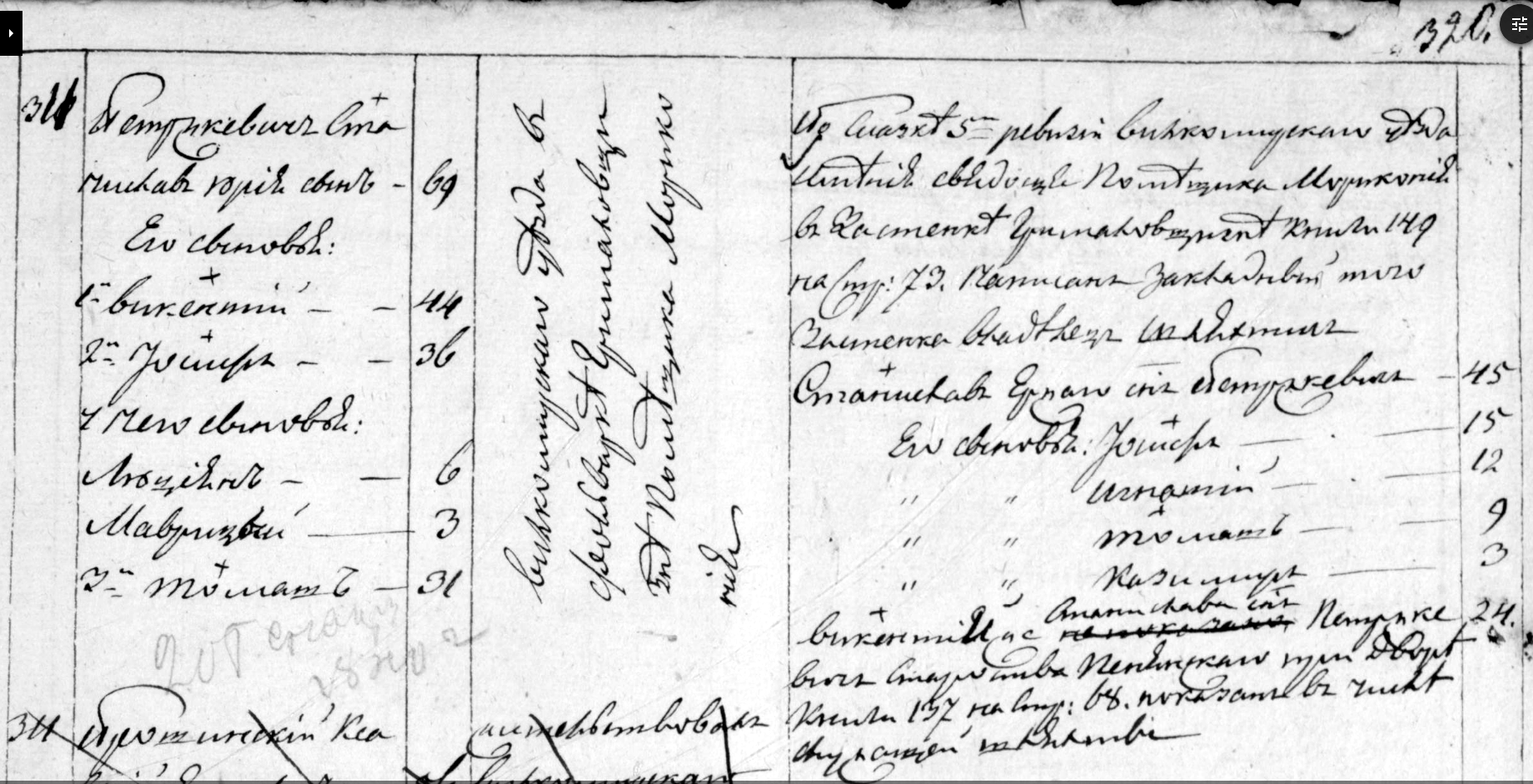
Update: In 1816, a population register (**ревизская сказка**) was compiled in Grzymałowszczyzna for the needs of the Vilnius Treasury Chamber. The register recorded the Pietrzkiewiczes: Stanisław, son of Jerzy, aged 69; his sons: Wincenty, aged 44, Józef, aged 36, with his sons Lucjan, aged 6, and Maurycy, aged 3; and Tomasz, aged 31. It was noted that Grzymałowszczyzna belonged to the Morykons. In the column referring to the previous, fifth revision, it was stated that at that time the following persons had been included in Grzymałowszczyzna: Stanisław, son of Jerzy, aged 45, and his sons: Wincenty, aged 24, Józef, aged 15, Ignacy, aged 12, Tomasz, aged 9, and Kazimierz, aged 3.
A page from the revision lists of the nobility of the Švenčionys, Ashmyany, Ukmergė and Šiauliai districts from 1816–1824, LVIA.
On 20 March 1817 Bogumiła Pietrzkiewicz née Fabrycjusz, wife of Stanisław, died at the age of 70. In the same year, on 9 April, the not quite two-year-old Julian-Michał died, and four months later, on 3 August 1817, another son of Józef-Kazimierz and Anna née Horodecka, Konstanty-Erazm, was born.
On 8 March 1818 Miss Ewa Pietrzkiewicz died in Grzymałowszczyzna, aged 67. She was probably the daughter of Jerzy Pietrzkiewicz and Urszula née Bem, and the sister of Stanisław, who, after the sale of Wadwy, took his unmarried sister with him to the leased Grzymałowszczyzna.
Stanisław Pietrzkiewicz died on 4 February 1819. After his death, the lease of Grzymałowszczyzna was continued by his son Józef-Kazimierz (1780–1844), since among Stanisław’s sons only Józef-Kazimierz’s children were born in Grzymałowszczyzna.
Three years later, on 4 August 1822, Anna Pietrzkiewicz, aged 40, probably the wife of Józef-Kazimierz, died in Grzymałowszczyzna.
Before 1827 Józef-Kazimierz married Anna née Karpuszko, since on 5 November 1827 their son Antoni was born in the Grzymałowszczyzna folwark, and on 24 January 1834 another son, Ignacy-Józef.
It is not known when Józef-Kazimierz’s lease of Grzymałowszczyzna ended or when the family moved to Piotrowszczyzna near Antuzów (Lith. Antazavė). Józef-Kazimierz died in 1844 and was buried in the parish cemetery in Antuzów.
The later history of Grzymałowszczyzna remains unknown.
Żyżmy
Coordinates: 55.41173, 24.42899
Żyżmy (Lith. Žižmiai) was formerly a group of estates belonging to various owners, situated in the Wiłkomierz (Lith. Ukmergė) district of the Vilnius Voivodeship, in the Pogiry (Lith. Pagiriai) parish, about 6 km north of Pogiry.
The locality of Zyzmy was mentioned in the printed report of the 1744 synod of the Diocese of Vilnius as belonging to the Pogiry parish.
In the 1784 description of the Pogiry parish, the parish priest, Father Benedykt Miłłaszewicz, listed numerous owners of estates situated in Żyżmy. There were the folwarks of Hoppen, Wyrzykowski, Kulesza and the Niekraszewiczes, the manor of Ordyniec, several petty-noble settlements belonging to the Chochołowskis, Jadkowskis, Romanowskis, Sawickis, Pietkiewiczes, Waszkiewiczes, Racieńces, Klemętowiczes, Wittorts, Żągałłowiczes, Daszkiewiczes and Gieduszkos, as well as a village belonging to the Pogiry presbytery.
According to the Nobility Verification of 1806, on 3 January 1805 Onufry-Jan Pietrzkiewicz, the third son of Antoni-Trojan, purchased the Żyżmy estate from Marcin Ordyniec and Izabella Ordyniec née Szukszta, colonels of the former Polish Army.
During the revision of 1816, Onufry, son of Antoni, together with his sons Robert and Hermenegild, was recorded as the owner of the Żyżmy folwark, which had 20 serfs.
The next information confirming the connection of the Pietrzkiewiczes with Żyżmy comes only from 1835. On 20 July 1835 Robert Pietrzkiewicz became godfather to Józef-Rajnold, son of Piotr and Aniela Szyling, born in the Żyżmy folwark. The witnesses included Ewa Pietrzkiewicz, Robert’s wife, and Miss Dominika Pietrzkiewicz.
In 1839 Robert Pietrzkiewicz appears as a witness at the baptism of Michał, son of Feliks and Anna Malicki, born in Żyżmy.
There is no later information concerning the Pietrzkiewiczes of Żyżmy.
Kirkucie
Coordinates: 55.35929, 24.48435
Kirkucie (Lith. Kirkučiai) was formerly an estate situated in the Wiłkomierz (Lith. Ukmergė) district of the Vilnius Voivodeship and belonging to the Pogiry (Lith. Pagiriai) parish; today it lies in the Ukmergė district. Kirkucie was located about 8 km in a straight line east of Pogiry. On satellite imagery, it now appears to be an uninhabited area, without buildings or a paved road.
In 1784 the parish priest of Pogiry, Father Benedykt Miłłaszewicz, while preparing a description of the parish, did not list Kirkucie among the localities belonging to it. Perhaps at that time Kirkucie formed an undivided part of a larger estate.
Kirkucie appears in the history of the Wadowski Pietrzkiewicz family relatively late, only in 1836. In the parish registers of the Pogiry church, under the date 3 May 1836, there is a record of the baptism of Władysław-Antoni, son of Michał-Dominik Pietrzkiewicz and Józefata née Choduszewicz, born in Kirkucie. Five years later, on 5 January 1841, Karol, son of Lucjan-Stanisław Pietrzkiewicz and Kazimiera née Waszkiewicz, was born in Kirkucie and was also baptized in the Pogiry church.
On the basis of these two records, it may be inferred that in 1836 and later Michał-Dominik, the father of Władysław-Antoni, lived in Kirkucie, probably as the administrator of someone else’s estate or in another capacity. This is confirmed by an entry in the 1858 list of the nobility of the Wiłkomierz (Lith. Ukmergė) district, which records that Władysław-Antoni Michałowicz Pietrzkiewicz, an unmarried man aged 22 and without landed property, lived in Kirkucie. No other Pietrzkiewiczes from Kirkucie were listed there.
On 2 January 1869 Wacław Wadowski-Pietrzkiewicz, son of Władysław-Antoni Pietrzkiewicz and Malwina née Iszor, was born in Kirkucie.
In Seweryn Uruski’s armorial, under the year 1882, Władysław, son of Michał, is listed among others as heir to the Kirkucie estate. In the Geographical Dictionary of the Kingdom of Poland (vol. XV, part 2), published in 1902, the entry on Kirkucie states that it was located in the Pogiry commune of the Wiłkomierz district, where estates were held by the Iwanowskis, Kamieńskis, Pietrzkiewiczes and Taraszkiewiczes.
However, neither the entries in Uruski’s armorial nor those in the Geographical Dictionary can be treated as proof that the Pietrzkiewiczes owned land in Kirkucie.
Piotrowszczyzna
Coordinates: 55.78485, 25.98731
Piotrowszczyzna (Lith. Petraučizna) was formerly a folwark and several small noble settlements, situated on Lake Dubury, south-east of the town of Antuzów (Lith. Antazavė), in the Wiłkomierz (Lith. Ukmergė) district of the Vilnius Voivodeship; today it lies in the Zarasai district.
In the report of the 1744 synod of the Diocese of Vilnius, Piotrowszczyzna was listed as a locality belonging to the Dusiaty parish.
In the description of the Dusiaty parish, then part of the Kupiškis deanery, prepared in 1784 by the dean of that time, Father Franciszek Klimowicz, the Piotrowszczyzna folwark belonged to the “Honourable Plater, starosta of Giegobrody” and was situated “to the summer east, at a moderate mile” from Dusiaty.
The “Honourable Plater” was Ludwik Plater, lord of Antuzów, Piotrowszczyzna and Grawenberg, who died in 1788. After him, the heir to Piotrowszczyzna was probably his son Franciszek-Ksawery, born in 1785, the son of Ludwik and Kunegunda née Wołowicz. By 1806, Franciszek-Ksawery’s first wife was Anna Mohl, of the Trzy Krety coat of arms, daughter of Dionizy, judge of Bracław. Their daughter was Emilia Plater. Franciszek-Ksawery died in 1837.
No later than 1842, perhaps because the lease had been terminated, Józef-Kazimierz Pietrzkiewicz left, together with his family, Grzymałowszczyzna, which had been leased since 1782, and moved to Piotrowszczyzna near Antuzów.
According to the account of Teresa Marchwicka née Pietrzkiewicz, the Pietrzkiewiczes were “connected” with the Platers. This connection was probably related to the appearance of the Pietrzkiewiczes in Piotrowszczyzna. It was also said to have been connected with the later appearance of the Pietrzkiewiczes in Tryszki in Samogitia, but there is no evidence for this.
The first document showing the connection of the Pietrzkiewiczes with Piotrowszczyzna is the marriage record of Józef-Kazimierz’s daughter, Michalina, to Konstanty Tołoczko, concluded in the parish church in Antuzów on 27 October 1842. The record states that the bride came from Piotrowszczyzna.
Two years later, on 24 January 1844, Józef-Kazimierz died and was buried in the cemetery in Antuzów, the first of many Pietrzkiewiczes buried there. In 1852 Konstanty Pietrzkiewicz and his wife Feliksa née Piotrowska were buried in Antuzów; they had drowned in Lake Czycziris on 3 January of that year.
After Józef-Kazimierz’s death, Piotrowszczyzna passed to Antoni, the elder son from his second marriage. This may have resulted from Józef-Kazimierz’s unknown last will or from other reasons. In any case, Antoni’s much older half-brothers, Lucjan-Stanisław and Wawrzyniec-Maurycy, were living with their families in Tryszki (Lith. Tryškiai) in Samogitia in the second half of the 1840s.
Before 1855 Antoni married Karolina née Maciejewska, with whom he had two sons: Józef-Zachariasz and Ignacy. Both died in early childhood. In 1860 Antoni’s wife Karolina also died. All of them were buried in the family tomb in Antuzów.
After the fall of the January Uprising, the brothers Lucjan-Stanisław and Wawrzyniec-Maurycy Pietrzkiewicz were deprived of their rights and deported to Siberia for their participation in the uprising. In addition, as part of the repression, the tsarist authorities confiscated 2/7 of the 308 dessiatins of land in the Piotrowszczyzna estate. At the same time, in December 1864, the tsarist authorities began the process of emancipating the peasants in Piotrowszczyzna, as a result of which the estate was reduced by a further 56 dessiatins of land.
In 1867 Anna née Karpuszko, widow of Józef-Kazimierz, died in Piotrowszczyzna at the age of 67.
On 9 August 1870, in the parish church in Antuzów, Antoni Pietrzkiewicz of Piotrowszczyzna married the widow Waleria Karpuszko née Baniewicz, also of Piotrowszczyzna. From this marriage, on 24 January 1876, Piotr-Sylwester Pietrzkiewicz was born in Osokno near Dusiaty. His godfather was Father Ignacy-Józef Pietrzkiewicz, then curate of the Church of the Blessed Virgin Mary in Szymańce (Lith. Šimonys).
Antoni Pietrzkiewicz died suddenly on 22 April 1885 during a visit to the Gornia estate. He was buried in the cemetery in Antuzów. The heir to Piotrowszczyzna was nine-year-old Piotr-Sylwester, who was soon sent to study at the Real Gymnasium in Riga and, after completing it, continued his education at Riga Polytechnic.
By a decision of 1897, the Kowno (Lith. Kaunas) District Court granted Piotr-Sylwester Pietrzkiewicz inheritance rights to the estate of his deceased father.
On 12 August 1901 Piotr-Sylwester married Teresa-Krystyna Antonowiczówna of Birżały, daughter of Walerian-Alojzy Antonowicz and Jakobina-Ludwika née Grużewska, of the Andrault de Buy coat of arms. A witness at the wedding was Dr Maurycy Pietrzkiewicz, son of the 1863 insurgent and Siberian exile Lucjan-Stanisław.
In the same year, 1901, Piotr-Sylwester leased Piotrowszczyzna to Alfons Krukowski for six years. In 1907 Piotr-Sylwester’s mother, Waleria Pietrzkiewicz née Baniewicz, acting on behalf of her son, leased Piotrowszczyzna to Adolf Możejko for the period from 1908 to 1914.
The Geographical Dictionary of the Kingdom of Poland (vol. XV, part 2, 1902) states that Piotrowszczyzna was a folwark and two zaścianki, situated in the Nowoaleksandrowsk district, in the Antuzów commune. According to this description, the Honestis held 61 dessiatins there, the “Pietraszkiewiczes” [sic] 149 dessiatins, and the Szejkos 95 dessiatins of land.
In 1909, by decision of the District Court in Kowno (Lith. Kaunas), the nobleman Piotr-Sylwester, son of Antoni Pietrzkiewicz, was granted ownership rights by acquisitive prescription to the immovable estate of Piotrowszczyzna, situated in the Kowno Governorate, in the Nowoaleksandrowsk district. At that time Piotrowszczyzna comprised a total of 84 dessiatins and 2,184 square sazhens, and the court valued it at 3,400 rubles. The court decision shows that Piotrowszczyzna also included: the Szejki manor farm, the Krukowski manor farm, the small noble settlement of Piotrowszczyzna belonging to Statulewicz, the small noble settlement of Duburajcie and the small noble settlement of Morgowani.
On 7 October 1917, in the office of the Petrograd notary Julian Zabielski at 6 Nevsky Prospekt, Piotr-Sylwester Pietrzkiewicz granted his wife an unlimited power of attorney to manage their joint property. At that time this property consisted mainly of Piotrowszczyzna.
During her stay in Vilnius, connected with the education of her sons, on 12 January 1920, in the Vilnius notarial office of Tadeusz Wróblewski, Teresa-Krystyna Pietrzkiewicz transferred the power of attorney received from her husband to Aniela Urban, probably Anelė Urbonaitė, a ward of Jakobina Antonowicz and Teresa’s friend.
By decision of the Land Reform Board, on the motion of the Land Reform Commission of the Zarasai district of 21 February 1924, the Piotrowszczyzna estate belonging to Piotr-Sylwester Pietrzkiewicz, with an area of 109 hectares, was taken over in its entirety as the property of the Lithuanian state.
Tryszki
Tryszki (Lith. Tryškiai) is a town in Samogitia, situated on the Wyrwita River, mentioned in sources as early as 1537. In the sixteenth century there was a Catholic church there, later taken over by the Evangelical Reformed community. At the end of the sixteenth century the locality was associated with the Szemet family.
In the seventeenth century Tryszki was associated with the Wołłowicz, Pac and Ogiński families. In 1685 there was a parish school there. In 1701, during the Great Northern War, Swedish and Lithuanian troops clashed near Tryszki, and the town burned down. In 1738 Tryszki had 19 taxable households, and in 1789 — 71. In 1751 the present wooden Church of the Holy Trinity was erected. In 1792 King Stanisław August granted Tryszki Magdeburg rights and a coat of arms. In 1793 the parish school was restored. During the November Uprising, in 1831, Tryszki was taken by the insurgents, and in the mid-nineteenth century the Tryszki manor belonged to Pietkiewicz.
No later than 1846, Wawrzyniec-Maurycy Pietrzkiewicz settled in Tryszki with his wife Julia née Rudnicka, since on 7 April 1846 their son Władysław-Paweł was born in the Tryszki manor, followed by further children: Kazimiera-Jadwiga (*1848), Ignacy-Gerard (*1849), Michał-Kwiryn (*1852), Maria-Jadwiga (*1854) and Jadwiga-Olimpia (*1862).
Following his brother, Lucjan-Stanisław also settled in Tryszki with his wife Kazimiera née Waszkiewicz. Their sons were born in Tryszki: Adam-Aleksander (*1848), Antoni-Kacper (*1852), and probably also their daughters: Stanisława, Łucja and Feliksa.
During the January Uprising, on 21 May 1863, near Tryszki, the insurgent detachment of Jan Staniewicz clashed with Russian troops. Two Józef Pietrzkiewiczes were killed in this battle: Józef-Feliks, son of Lucjan-Stanisław, and Józef-Jakub, son of Wawrzyniec-Maurycy.
It is not known how long the Pietrzkiewiczes held Tryszki after the January Uprising. After returning from exile, Lucjan-Stanisław settled in Kalkuny near Dyneburg. His son, Dr Maurycy, also lived there after twenty-five years of service in Siberia. Lucjan’s second son, Karol, rose to the rank of colonel in the Imperial Life Guard and founded the Moscow line of the Pietrzkiewicz family. His younger brother Antoni-Kacper was a physician in the tsarist army.
Among the children of Wawrzyniec-Maurycy, the eldest daughter, Karolina, married Nikodem Iwanowski, with whom she had daughters Zofia and Maria, writers known under the literary pseudonym Lazdynų Pelėda. The fate of Władysław-Paweł is unknown. Ignacy-Gerard became a chemical engineer and settled in Warsaw, where his father, Wawrzyniec-Maurycy, returned after exile. Michał-Kwiryn was the first pharmacist in Cytowiany. Maria-Jadwiga married Stanisław Witkiewicz, with whom she had a son, Stanisław-Ignacy, known as Witkacy, and Jadwiga-Olimpia became the wife of the historian Ernest Świeżawski.
Malinówka
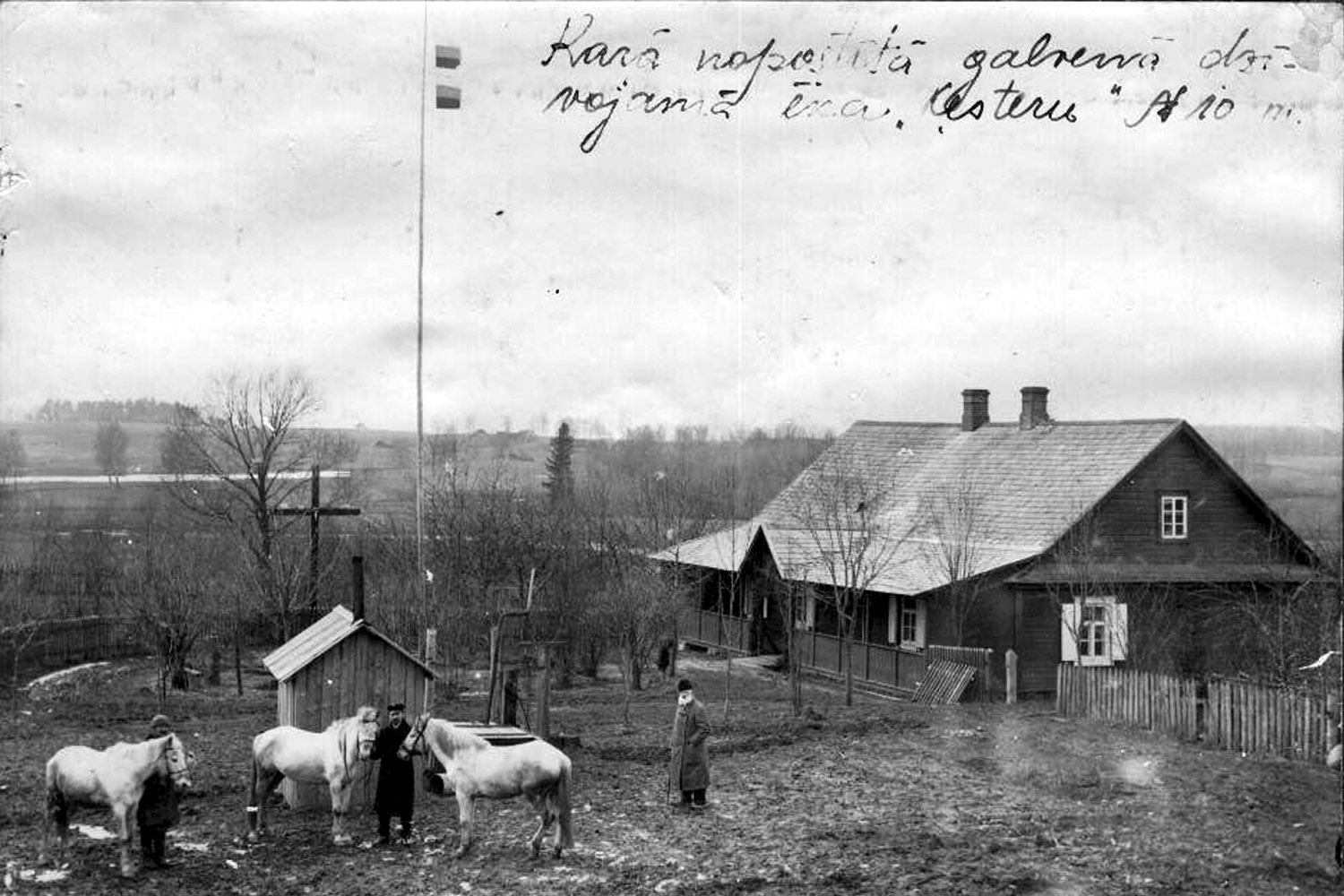
Malinówka and Dr Maurycy, early 20th century – M. Porter archive
Coordinates: 55.83212, 26.46482
Malinówka alias Koster No. 10 – an estate purchased in 1873 by Lucjan-Stanisław Pietrzkiewicz after his return from exile in Tobolsk, Siberia. Lucjan bought it for 3,000 rubles from Dr August Georg Friedrich von Oettingen (1823–1908), a Baltic German lawyer, politician and owner of the Kalkuny and Medumy estates near Dyneburg. In 1862–1868 von Oettingen served as civil governor of Livonia, and in 1886–1889 he was mayor of Riga.
The purchase agreement for Malinówka shows that Lucjan paid 450 rubles in cash. The remaining amount was to be paid over ten years, in annual instalments with interest. The German original of the agreement, on which notes concerning the payments have survived, shows that the debt was paid regularly and was fully settled in 1883.
The German-language version of the purchase agreement for Koster No. 10 shows that the original purchaser of the estate was to have been Lucjan’s son Karol, at that time a captain in the Life Guard Horse Grenadier Regiment. His name was crossed out and replaced with Lucjan’s. This may suggest that the transaction was initially considered through the son, as a person less politically burdened than his father, an insurgent of 1863. It also cannot be ruled out that the choice of an estate in this location was influenced by the contacts of Lucjan’s younger brother, Father Ignacy-Józef Pietrzkiewicz, who in 1868–1871 was curate of the church in Łałkiesa (Latv. Laucesa).
On 19 May 1877 Lucjan’s wife, Kazimiera née Waszkiewicz, died. She was buried in the parish cemetery in nearby Łałkiesa. Three years later, on 26 May 1880, Lucjan-Stanisław died at the age of 70 and was buried beside his wife. This suggests that the final instalments for the purchase of Malinówka were probably paid by his son, Dr Maurycy Pietrzkiewicz.
Dr Maurycy retired from service in 1886. Probably for this reason, the inheritance matters after Lucjan were settled only in 1887, after Maurycy’s arrival from Tobolsk to Malinówka. From an extract from the mortgage records concerning Koster No. 10, we learn about the history of the estate’s acquisition by Lucjan Pietrzkiewicz, the date of his death, and the fact that his statutory heirs were: Dr Maurycy Pietrzkiewicz, Colonel Karol Pietrzkiewicz, Antoni Pietrzkiewicz, Michalina Pietrzkiewicz, Stanisława Pietrzkiewicz, Łucja, married Sabińska, and Felicja, married Groniewicz (Gruniewicz?). The document shows that Dr Maurycy Pietrzkiewicz’s siblings submitted declarations in which they renounced, in his favour, the inheritance rights due to them after their father. It is also worth noting that in 1887 the name Malinówka was already in official use alongside the former mortgage name Koster No. 10. On the basis of this document, one may put forward the hypothesis that it was in fact Dr Maurycy Pietrzkiewicz who from the beginning financed the purchase of Malinówka, in order to secure his parents’ livelihood as close to Lithuania as possible.
After returning from Siberia, Dr Maurycy ran a private medical practice in Dyneburg in 1892–1910 as a physician specializing in women’s diseases and obstetrics.
In 1903 the following advertisement appeared in the Dvinsk Gazette (Двинский листок):
"A summer dacha is available for rent at the Malinówka estate, situated 2 versts from Kalkuny station. It is a newly finished summer house with five rooms, a large veranda and all conveniences. Further information and rental terms may be obtained on site from Dr Pietrzkiewicz.”
In 1910 Dr Maurycy drew up a testament in which he disposed of his property and bequeathed the Malinówka estate to his son Michał-Otton. He died two years later, on 31 March 1912, and was buried in the parish cemetery in Łałkiesa, beside the graves of his parents, together with his wife Zofia née Jankowska.
The next and last owner of Malinówka was Michał-Otton Pietrzkiewicz (1871–1960), a geological engineer. In 1911–1913 he stayed in Kazakhstan in connection with his professional work, as shown both by his daughter’s baptismal certificate from 1911, issued in Ust-Kamenogorsk, now Öskemen, and by the testament he drew up in 1913 in Semipalatinsk. In the spring of 1918 he was in Petrograd.
Malinówka certainly remained in Michał-Otton’s possession throughout the entire period of independent Latvia. There is no information about the fate of the estate during the first Soviet occupation. In 1944 Michał-Otton, together with his wife and daughter Julia, left Latvia ahead of the advancing Red Army. After staying in a transit camp in Germany, he emigrated with his family to Australia, where he died in 1960.
Birżały
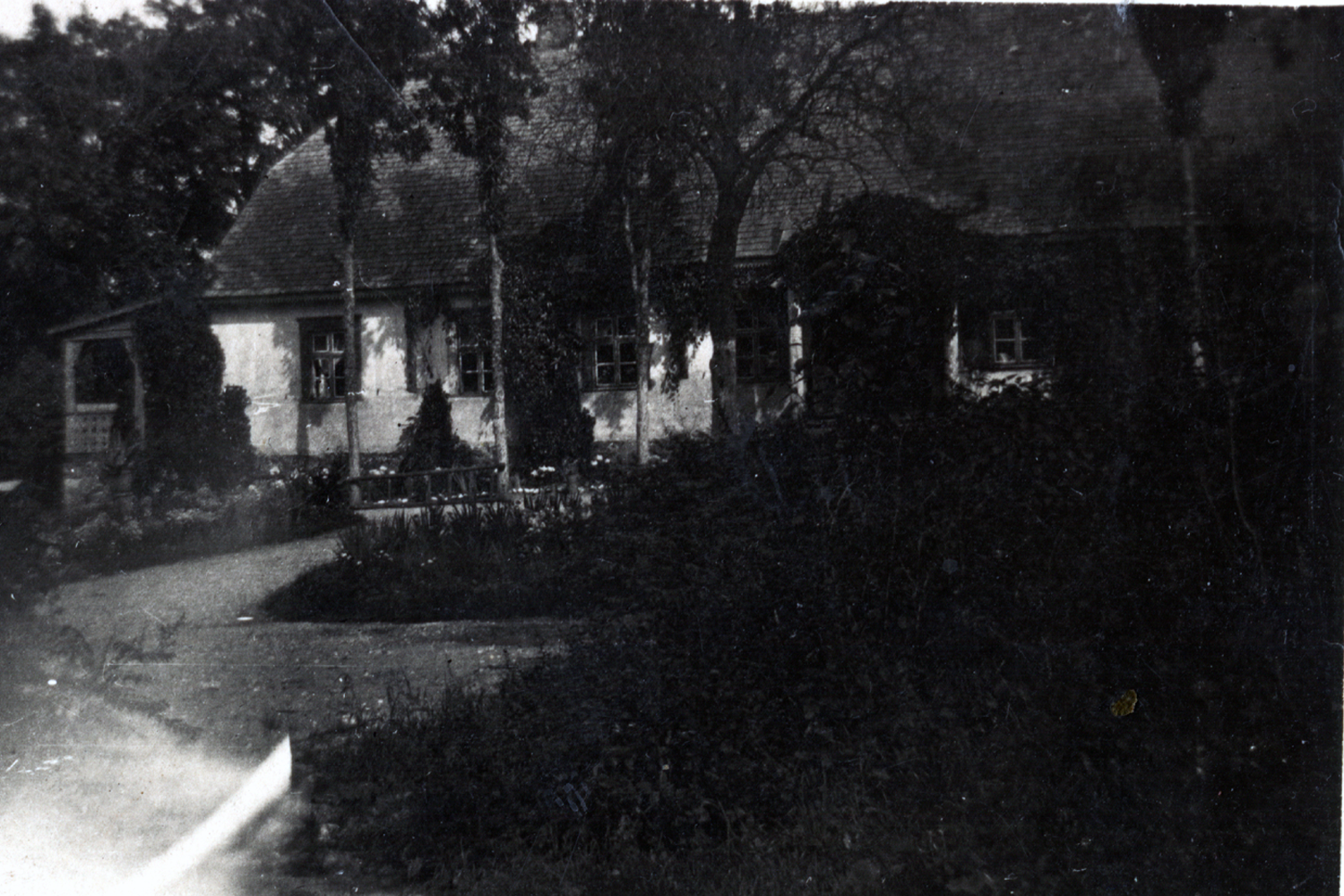
Birżały, Teresa Pietrzkiewicz’s manor house – 1920s.
Coordinates: 55.88742, 24.27884
Birżały (Lith. Birželiai) was formerly an estate and manor in the Upita district of the Vilnius Voivodeship, in the Pompiany (Lith. Pumpėnai) parish; today it lies in the Pasvalys district.
In the 1784 description of the parishes of the Wiłkomierz (Lith. Ukmergė) deanery, Birżały was listed among the localities belonging to the Pompiany parish. The parish priest, Father Anjoł Giecewicz, recorded that Birżały was a manor and village belonging to “the Honourable and Illustrious Mr Micewicz, cavalry captain of the Upita district”, and that it lay “a large mile from the Pompiany church, on the Ławena River (Lith. Lėvuo), between south and winter west”.
At the beginning of the nineteenth century the Birżały manor already belonged to the Staniewicz family. In 1814 Wiktor-Władysław Jasieński, of the Jastrzębiec coat of arms, cavalry captain of the Upita district, born in 1787 in Wismonty, married Barbara née Staniewicz, from the Birżały manor, in the church in Nowe Miasto.
In 1844 their daughter, Rozalia-Józefata Jasieńska, from the Birżały manor, married Wincenty-Ananiat Landsbergis in the church in Pompiany (Lith. Pumpėnai). He was a widower, a lieutenant in the Russian army, from the Kompanszczyzna manor in the Linków parish. Their son Gabriel Landsberg, later known as Gabrielius Landsbergis-Žemkalnis, was born in 1852. It is possible that he was born in his mother’s manor, in Birżały, in the Pompiany parish.
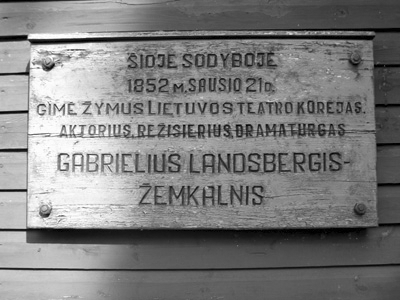
Birżały. Information board on the building standing on the site of the demolished manor house – 2001.
From the above, it may be inferred that Wiktor-Władysław and Barbara Jasieński née Staniewicz were living in Birżały in 1844. However, without access to the original baptismal record of Gabriel Landsberg, it cannot be confirmed whether he was in fact born in the Birżały manor. It is also still unknown who owned Birżały in 1852.
Before the January Uprising, Birżały belonged to Krzysztof-Florestan Grużewski, of the Lubicz coat of arms, son of Józef-Leonard. Krzysztof and his wife Zofia née Mniszewska had a daughter, Jakobina-Ludwika (1859–1923).
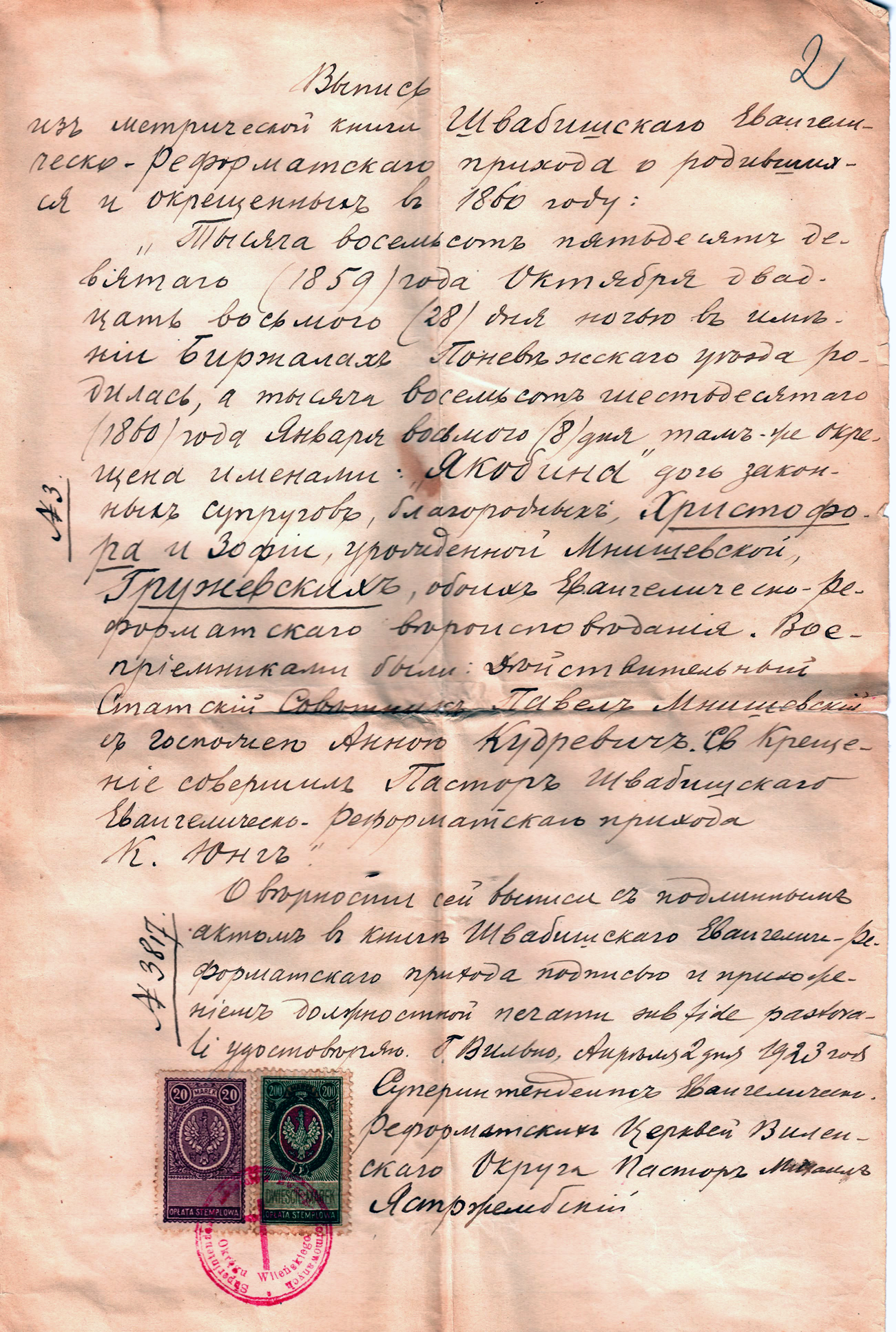
Birżały. Copy of the baptismal record of Jakobina-Ludwika Grużewska.
Krzysztof Grużewski took part in the January Uprising as the representative of the National Government for the Poniewież district. He fought in the battle of Medejki/Gudziszki and, according to Lithuanian sources, it was there that he fell. According to family tradition, the mortally wounded Krzysztof was taken from the battlefield by his subordinates and by peasants from Birżały bearing the surname Bagdon (Bagdonas), who brought him back to his home in Birżały. As a reward, they were said to have received the right to bury their dead in the Grużewski family cemetery.
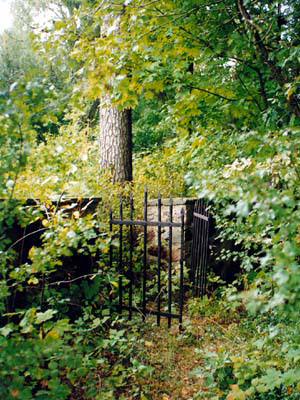
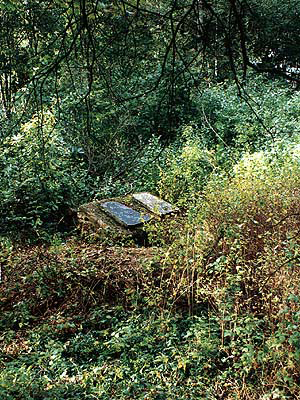
Birżały. Gate to the small cemetery, later stolen, and the plundered Grużewski tomb – 1997.
The writer Gabriela Pietkiewiczówna (Petkevičaitė), who used the pseudonym Bitė, claimed in her memoirs that Krzysztof Grużewski had been killed near Birże. To prevent the manor from being confiscated and to protect Grużewski’s wife and young daughter, the writer’s father, Dr Jan Pietkiewicz, a friend of the Grużewski household, issued a death certificate stating that Grużewski had died of pneumonia. This made it possible to bury the owner of Birżały in the local family cemetery.
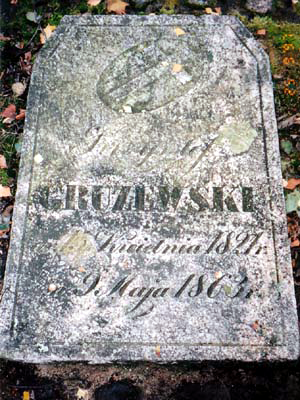
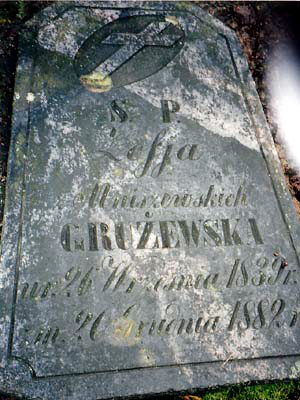
Birżały. Memorial inscription plaques on the Grużewski tomb – 1997.
After Krzysztof Grużewski’s death, the underground National Government appointed his wife Zofia as commander of the uprising in the Poniewież district. Soon afterwards, Zofia was arrested on charges of maintaining contacts with the insurgents and supplying them with provisions. She spent about two years in prison in Poniewież, together with her young daughter Jakobina. After paying a fine of 200 rubles, she was released from prison on 17 July 1865. She died on 20 December 1882, at the age of 43, from health complications caused by her imprisonment.
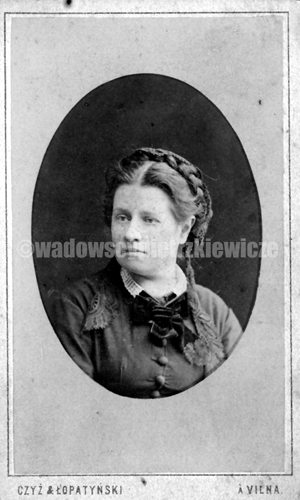
Zofia Grużewska née Mniszewska
After her mother’s death, ownership of Birżały passed to her daughter Jakobina-Ludwika, who was then 23 years old. Jakobina was already married at that time. Her husband was Walerian-Alojzy Antonowicz, of the Andrault de Buy coat of arms, a banker from Poniewież and a man considerably older than she was, son of Collegiate Councillor Józefat Antonowicz and Teresa née Dąbrowska, owners of the Jasnogórka estate near Poniewież. Their wedding took place on 5 August 1877.
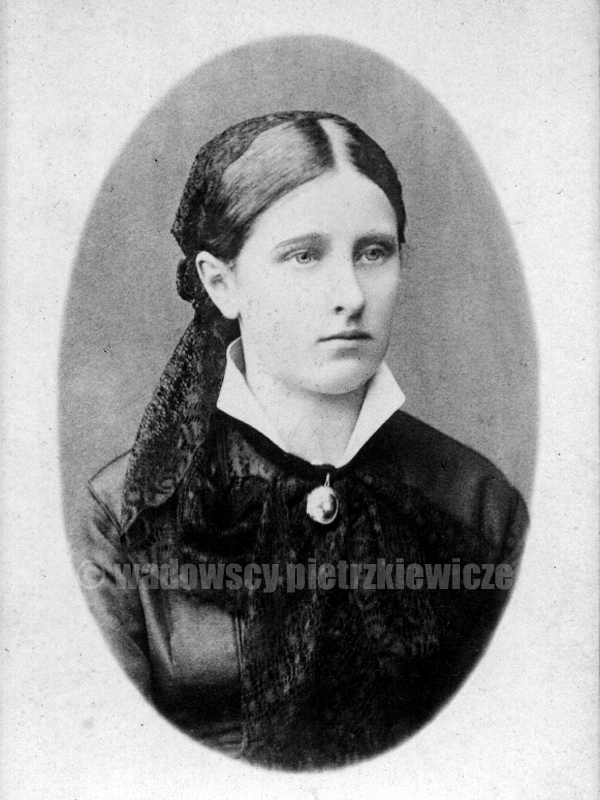
Jakobina-Ludwika Grużewska “of Młodzianów”, of the Lubicz coat of arms
It seems that this was a marriage of convenience rather than affection, and not a very successful one. Jakobina’s ailing mother probably wished in this way to secure her daughter’s future. In later years the spouses lived separately: Jakobina on her estate, and Walerian in his house in Poniewież.
From this marriage, Teresa-Krystyna Antonowiczówna was born on 30 May 1879. She was baptized on 22 June 1879 in her father’s manor in Jasnogórka by Pastor Neumann of the Evangelical Reformed parish in Szwabiszki. Her godparents were: the nobleman Józefat Nikolayevich Antonowicz and the noblewoman Zofia Pavlovna Grużewska, the nobleman Kalikst Tadeushevich Owsiany and the noblewoman Teresa Dementyevna Antonowicz, and the nobleman Stanisław Józefovich Szenfer and the noblewoman Helena Józefatovna Owsiana.
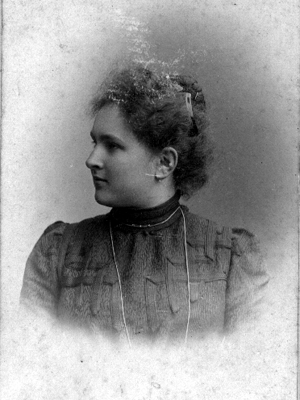
Teresa-Krystyna, daughter of Walerian and Jakobina née Grużewska Antonowicz, of the Andrault de Buy coat of arms
Jakobina Antonowicz née Grużewska was regarded in the family as a “Lithuanophile”, because she considered it necessary to educate the children of Lithuanian peasants in their own language. She financed the education of talented young people from the area, brought in teachers of Lithuanian nationality, and supported the local Lithuanian educational community. According to family recollections, among those she helped were Antanas Smetona, later President of Lithuania, and Juozas Zikaras, later a well-known Lithuanian sculptor. Zikaras continued to visit the Birżały manor in the 1920s.
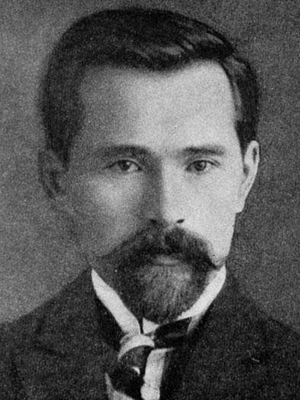
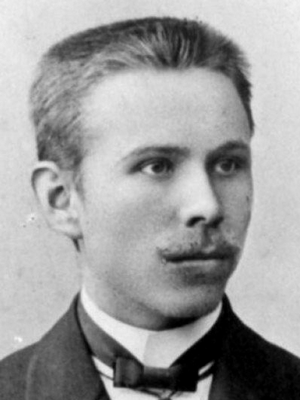
Antanas Smetona, 1911 r. (LMAVB) i Juozas Zikaras, 1910 r. (www.15min.lt)
Gabriela Pietkiewiczówna-Bitė, a writer, publicist, teacher and one of the important figures of the Lithuanian national revival, also belonged to Jakobina Antonowicz’s social circle. Teresa Marchwicka née Pietrzkiewicz recalled that, together with her grandmother, she visited the elderly Gabriela in Poniewież and had long conversations with her in Polish.
Anelė Urbonaitė, remembered in the family as “Aunt Aniela”, also belonged to this family circle. She was a village girl from the area of Birżały, whom Jakobina helped to obtain an education. In Lithuanian sources she appears as Anelė Urbonaitė or Urbonavičiūtė: the first Lithuanian teacher at the school in Pompiany (Lith. Pumpėnai), a long-time teacher of Lithuanian and Russian, a social activist, and a long-time friend of Teresa-Krystyna Pietrzkiewicz. According to Lithuanian sources, she was also the first love of Juozas Zikaras.
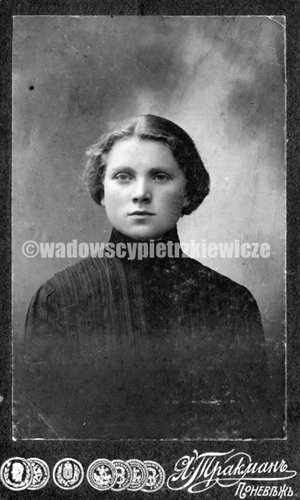
Anelė Urbonaitė
On 15 November 1886, by decisions of the Chamber of Joint Courts and the District Court in Kowno (Lith. Kaunas), Jakobina Antonowicz’s inheritance rights to the Birżały estate after Krzysztof and Zofia Grużewski were confirmed. The estate comprised 310 dessiatins, or 338.7 hectares.
On 12 August 1901, in the Birżały estate, the wedding took place of Teresa-Krystyna, daughter of Walerian-Alojzy and Jakobina-Ludwika née Grużewska Antonowicz, to Piotr-Sylwester Pietrzkiewicz, son of Antoni and Waleria née Baniewicz. The witnesses to the marriage were Robert Karpuszko, Dr Maurycy Pietrzkiewicz and Ludwik Ciemnołoński. Three sons were born from this marriage: Antoni-Wacław (*1902) in Birżały, Tadeusz (*1903) in Windawa, and Andrzej-Władysław (*1906) in Archangelsk.
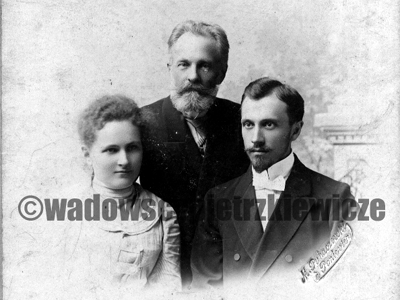
Teresa-Krystyna Pietrzkiewicz with her father Walerian Antonowicz and her husband Piotr, Poniewież, 1901
In 1911 Jakobina Antonowicz purchased from Maria Puzynina the Lieknas folwark, with an area of 39 dessiatins, or 42.6 hectares, situated by the Banieny manor in the Pompiany commune, in the Poniewież district.
After the outbreak of the First World War, during the retreat of the Russian army before the German forces, Jakobina Antonowicz née Grużewska left Lithuania together with her husband Walerian, most probably as part of the forced wartime evacuation into the interior of Russia. They both ended up in Petersburg, with their daughter Teresa-Krystyna Pietrzkiewicz. Walerian Antonowicz died there at the end of 1915 and was buried in Petersburg.
There is no information about Birżały during the German occupation. According to the account of Teresa Marchwicka née Pietrzkiewicz, daughter of Antoni-Wacław, the Birżały manor was plundered during the war and the Bolshevik occupation of Poniewież, and books and newspapers from the manor library were used to paper the walls of peasant cottages.
Jakobina Antonowicz returned to Birżały in June 1918 together with her daughter Teresa-Krystyna and Teresa’s sons: Antoni-Wacław, Tadeusz and Andrzej.
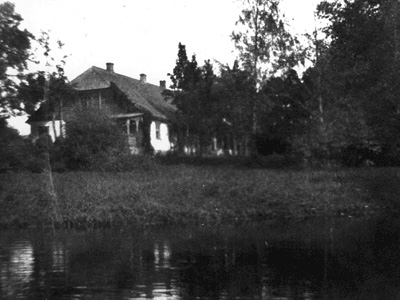
Birżały. View of the manor house from beyond the Ławena River – 1920s.
On 16 January 1920 Jakobina Antonowicz née Grużewska signed her testament before the notary Teodor Ludkiewicz in Poniewież, in the presence of witnesses: Antoni Ławrynaitis, Józef Sobolewski and Gabriel Woronicz. She bequeathed all her property, consisting of the Birżały manor with an area of 189 dessiatins and the Lieknas folwark with an area of 39 dessiatins, to her only daughter, Teresa-Krystyna Pietrzkiewicz née Antonowicz.
The interest on the accumulated capital she allocated as financial assistance for a poor Polish student of the Polish Gymnasium in Poniewież who distinguished himself in his studies. She appointed as executors of the testament Benedykt Karp, son of Franciszek, Józef Baniewicz of Johaniszkiele, Zygmunt Jasiński, son of Wojciech, of the Podlasie manor, and Antoni Grabowski of the Puki folwark.
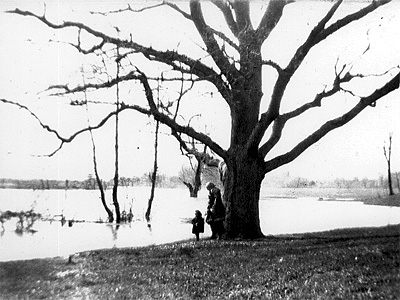
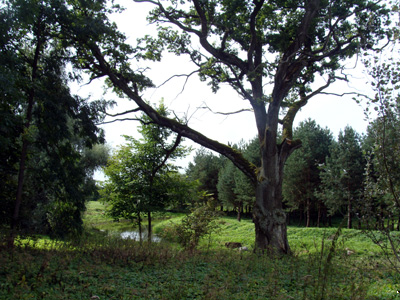
Birżały. The Birżały oak – in the 1920s and in 2001.
On 21 June 1921, the Commission for the Takeover of Private Forests drew up in Birżały two acts of takeover concerning forests belonging to Jakobina Antonowicz, situated in the Pompiany commune. The Birżały manor forest taken over by the state, with an area of 46.4 hectares, was covered mainly with spruce and black alder. The second complex, a forest called Lieknas, with an area of 40.4 hectares, was partly pine forest, with numerous clearings and logging areas, as well as meadows and wet wasteland. In total, nearly 87 hectares of forest were taken from Jakobina Antonowicz.
Jakobina Antonowicz née Grużewska died on 27 January 1923 and was buried in the family cemetery in Birżały. Her grave was destroyed after 1946.
In 1925 Jakobina’s daughter, Teresa-Krystyna Pietrzkiewicz, returned from Vilnius to Birżały with her son Andrzej. She found the estate ruined and, in addition, subject to land reform. As part of this process, in 1926, after the District Court in Poniewież had confirmed Teresa Pietrzkiewicz’s inheritance rights after her deceased mother, the Land Reform Office permitted her to sell land to local peasants: 12 hectares to Jan Bogdon, 20 hectares to Franciszek Stakele, 10 hectares to Jan Petrauski, 12 hectares to Antoni Liepa, and again 6 hectares to Jan Bogdon. In 1928, by another decision of the Land Reform Office, more than 150 hectares of land were expropriated from Teresa Pietrzkiewicz.
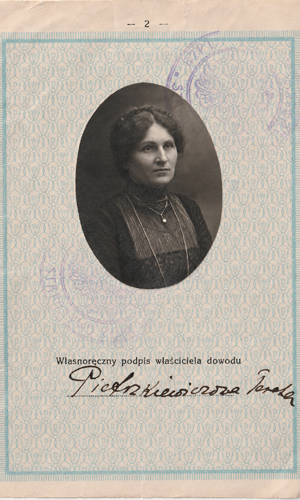
Teresa-Krystyna Pietrzkiewicz née Antonowicz, photograph from her Polish identity card, 1922.
In 1926 Teresa Pietrzkiewicz leased the Birżały estate to Władysława Legiejkowa for a period of six years, until 23 April 1932. On 15 December 1928 the agreement was extended until 1935.
In 1929, because Piotr-Sylwester Pietrzkiewicz had had the entire Piotrowszczyzna estate confiscated without being left the non-expropriable norm of 80 hectares, the Land Reform Office permitted Teresa Pietrzkiewicz to use 25 hectares of forest. This decision, however, was ultimately not carried out.
In 1935 the Land Reform Office finally determined the size of the estate left to Teresa Pietrzkiewicz. Of the 249 hectares inherited from her mother, 84.5 hectares of land remained in Birżały.
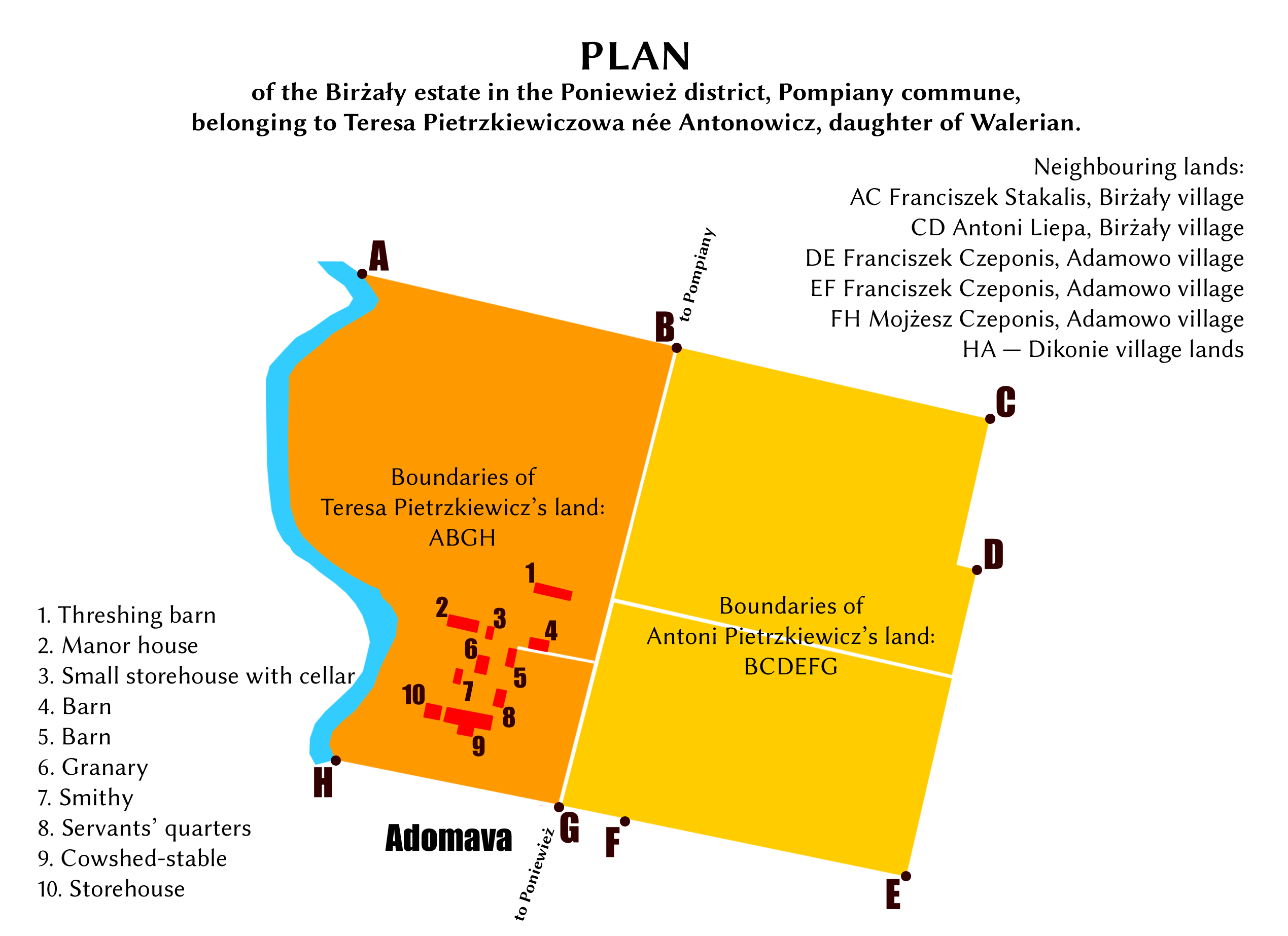
Plan of the Birżały estate belonging to Teresa Pietrzkiewicz née Antonowicz – state after the land reform, 1939.
In 1940 the Soviet Union, under the Ribbentrop–Molotov Pact, annexed Lithuania. The Soviet authorities took almost the entire estate from Teresa Pietrzkiewicz, leaving her only 13 hectares of land. The remaining part was distributed among smallholders and the landless. The farm buildings were assigned for use as the machinery base of a kolkhoz, while the manor house was turned into a primary school. This situation did not last long, but it brought the estate to ruin.
After Lithuania was occupied by German forces in 1941, the occupation authorities ordered landowners to return to their estates. At that time Teresa Pietrzkiewicz’s son Antoni-Wacław settled in Birżały with his wife Emilia. As it turned out, this was only for a short time, because already in 1943 the Germans began to evict Polish landowners. The Pietrzkiewiczes were ordered to leave the estate within 12 hours and hand it over to German colonists, Johann and Emilia Baur. Antoni-Wacław and his wife Emilia née Szymkiewicz left Birżały and moved to stay with Emilia’s brother in Łokiany near Wiłkomierz, where their daughter Zofia was born.
In the autumn of 1941 Jadwiga Pietrzkiewicz née Zielińska, wife of Tadeusz, after her husband had been arrested by the Germans, left Wołożyn with her sons Andrzej and Leszek and moved to her mother-in-law in Poniewież, and later to Birżały. After Antoni and Emilia Pietrzkiewicz were evicted from Birżały, she remained there as a gardener.
In 1944, after the front had passed, Birżały again came under Soviet rule. Antoni-Wacław Pietrzkiewicz returned from Łokiany to Poniewież with his wife and daughter, and soon afterwards to Birżały. At the end of 1944 or the beginning of 1945, Antoni-Wacław was arrested on charges of collaboration with the Germans. After two years in prison in Poniewież, in January 1947 he was deported to Siberia, where he perished in 1951.
On 1 April 1946 Teresa Pietrzkiewicz née Antonowicz died in Poniewież. She was buried in the family cemetery in Birżały.
By 1997 no trace remained of her grave or of the grave of her mother, Jakobina Antonowicz née Grużewska, the “Lithuanophile”. The graves of the January Uprising insurgents Zofia and Krzysztof Grużewski had also been dug up and plundered. The manor house in Birżały, a silent witness to the history of the Staniewicz, Jasieński, Landsberg, Grużewski, Antonowicz and Pietrzkiewicz families, was destroyed, and on the seized land the Soviet authorities established a kolkhoz. By then, all that remained of it were weed-covered, crumbling buildings and rusting remnants of agricultural machinery.
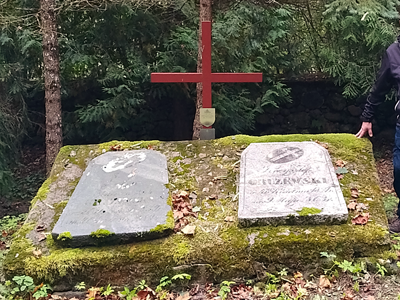
Birżały, the tomb of Zofia and Krzysztof Grużewski and the cross dedicated to Jakobina Antonowicz née Grużewska and her daughter Teresa-Krystyna Pietrzkiewicz, 2025
Birżały was the last remaining piece of family land in Lithuania to which our hereditary right had been confirmed by the independent Lithuanian state. It remains in our memory not only because of its history and the loved ones buried there, but also because it was taken by force, and the present state of affairs is the entrenched consequence of Soviet lawlessness.